
The Intellectual Gym: Jeremy Ebobisse’s Edge Off the Pitch
Inside the MLS striker’s unconventional approach to private markets investing.
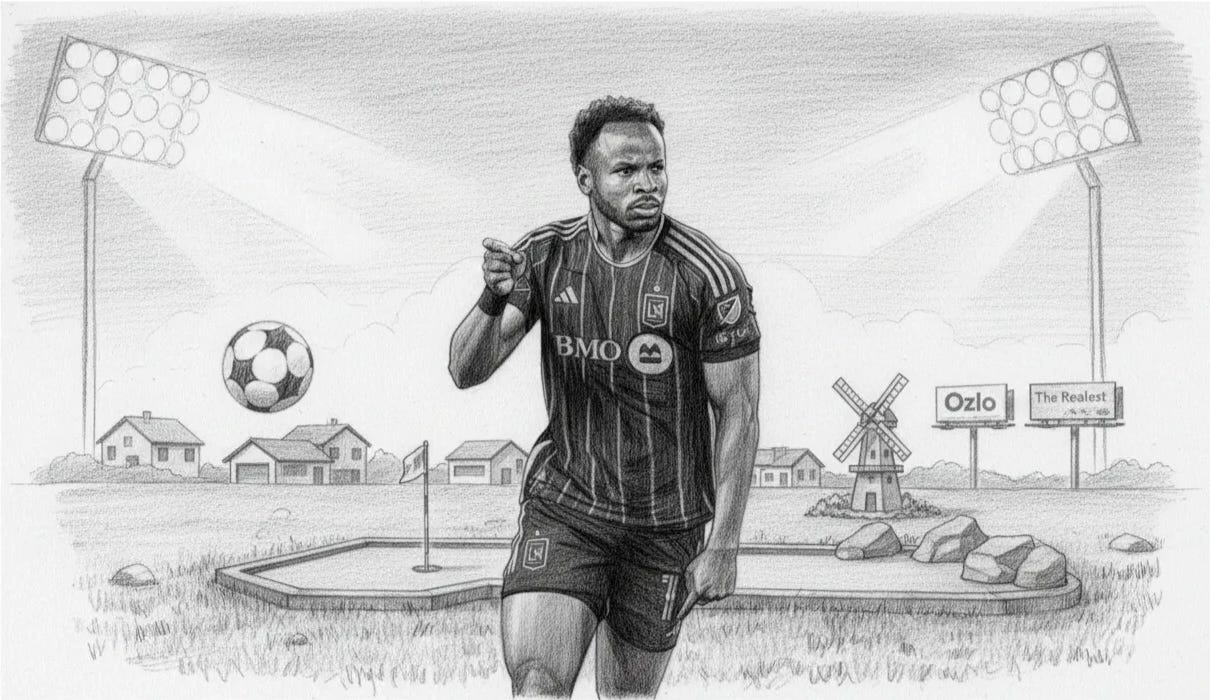
I recently sat down with Jeremy Ebobisse to talk about how he invests in private markets.
A decade ago, that sentence alone would have surprised me. Back then, “athlete investor” wasn’t a recognized category. Athletes earned money. Investors decided what to do with it. The roles were mostly separate. But that separation has quietly eroded. Access has broadened, information is less scarce, and private markets no longer require the same set of gatekeepers they once did.
What struck me about Jeremy wasn’t that he invests, or even what he invests in. It was the how.
When I speak with athletes about money, many of them describe investing as something they engage with opportunistically. Over time, this tends to produce portfolios that resemble drawers of souvenirs: interesting to look through, but without much underlying thesis.
Jeremy approaches investing differently. He treats his portfolio as an intellectual gym - something he shows up to deliberately. He doesn’t wait for opportunities to find him. He actively seeks them out. Different investments train different muscles, and early on, the goal isn’t to maximize immediate returns or secure his retirement. It’s to build the capacity to make better investment decisions over time.
What became clear in our conversation was that the real risk isn’t making a few bad investments. It’s reaching the end of his playing career without having built the judgment to deploy his wealth effectively.
Portfolio Construction: Treating Diversification as Education
Much of the conventional financial advice given to athletes emphasizes wealth preservation. So the prescription is almost always the same: diversify broadly, stick to safe assets, and preserve capital.
So by conventional standards, Jeremy’s portfolio would raise some eyebrows.
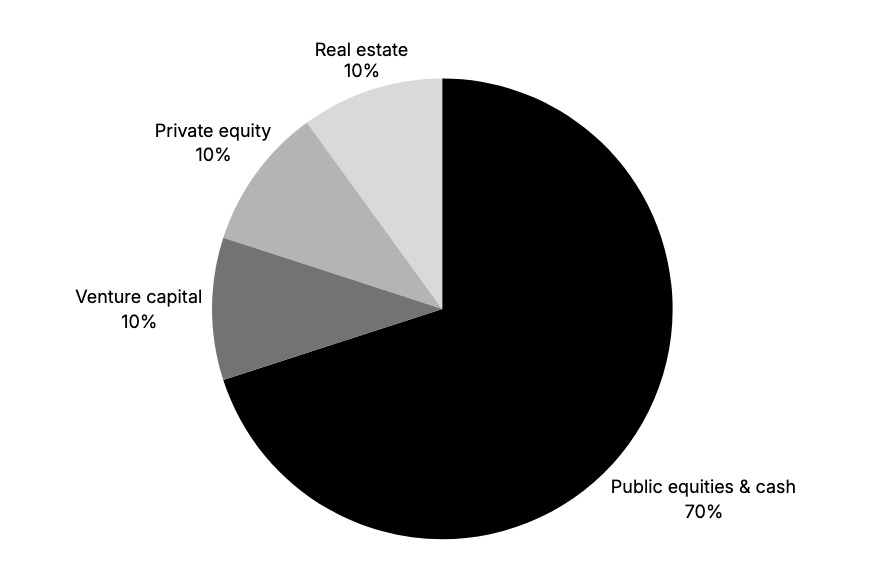
Roughly 70% sits in public equities and savings. The remaining 30% is in private investments, which includes venture capital, private equity, and real estate. That’s nearly double the illiquid exposure financial advisors typically recommend.
“It’s more aggressive than what most advisors would recommend,” he said. “But I’m young, and I can afford to learn.”
Most investors use diversification to minimize volatility. Jeremy uses it to broaden exposure. Instead of asking, How do I protect my capital? he’s asking, What do I want to understand next?
Each asset class teaches him something different about how capital behaves. Each investment exposes trade-offs, constraints, and second-order effects that only become visible from having skin in the game.
“This is the phase of my life where learning has the highest return,” he told me. “I’d rather over-index on that now and de-risk later than do the opposite.”
What most people miss, and what Jeremy intuitively understood, is that portfolios can be optimized for learning, not just returns, especially since he doesn’t need the money right away. When approached this way, the logic of diversification changes entirely.
Jeremy isn’t just diversifying across asset classes. He’s diversifying across learning opportunities. And in this phase of his career, that might be the most valuable form of diversification.
VC Funds: Learning From the Pros

Getting traded from Portland to San Jose dropped Jeremy into the Bay Area’s tech ecosystem. And watching NBA players like Andre Iguodala and Kevin Durant invest in startups sparked his interest.
Like most athletes, he started with what he knew.
The problem is that athletes are magnets for celebrity-adjacent deals like sportstech and consumer brands. Categories like enterprise software, AI infrastructure, and hardware rarely show up in Jeremy’s DMs.
That changed when he connected with Next Legacy Partners. Instead of pitching him deals, they took him under their wing. Through their events and introductions, he got access to the broader tech ecosystem.

Investing as an LP in VC funds was the logical next step. It gave him exposure to a much broader slice of the market, to startups he'd never have seen otherwise.
His first commitment was to 640 Oxford. He liked their thesis: applying technology to antiquated industries to re-industrialize America. So he invested.
The fund has shown strong early returns on paper. But Jeremy got lucky. At the time, he couldn’t articulate what edge the fund had or how to distinguish truly great fund managers from merely good ones.
“I didn’t have a framework yet,” he told me. “I just knew I really liked the team. They also had a strong thesis, which felt contrarian at the time.”

As he evaluated more funds, he started noticing patterns.
The strongest funds had strategies where the math actually worked - the fund size, stage focus, and check size all aligned perfectly with the opportunities they were chasing. The ones he avoided were the funds whose strategy boils down to raising a big fund and chasing the hottest deals.
He looked for fund managers with a distinct edge. Venture returns follow power laws: most of the upside comes from a small fraction of startups. If a fund couldn’t show how it could access the best deals consistently, it’s optimizing for average outcomes in a game designed for outliers.
He also learned to distinguish between people motivated by craft and people motivated by status. In a world full of people chasing the VC investor label, being able to spot who’s actually in it for the long haul matters.
The lessons filtered out bad funds. But the bigger payoff came from what the good ones taught him.
Over time, Jeremy began to view LP investing as asymmetric education. For the cost of a single check, he gained direct access to decision-making frameworks that would have taken years to build on his own - how professionals source deals, build conviction, and know when to pass.
The fund managers he backs aren’t just deploying his capital. They’re also compressing his learning curve.
Early-Stage Startups: Betting on Lived Experience
LP investing lets Jeremy study the professionals. Direct startup investments are where he tests his own judgment.
South Park Commons helped sharpen that judgment. He spent much of 2024 surrounded by deeply technical founders building companies from zero to one. The community taught him to separate conviction from hype and to think bigger about what’s possible.

He focuses on asymmetric bets rooted in his own lived experience. I call these “Jeremy deals” - investments where the product solves a problem he understands viscerally.
Take Ozlo. As an athlete, sleep isn’t just comfort. It’s a performance requirement. Traveling to busy cities like New York or LA for away games means dealing with noise and inconsistent rest. When Jeremy saw Ozlo’s sleep buds, he wasn’t reacting to a market trend. He was reacting to a problem he’d lived.
The same logic applied to The Realest, a memorabilia authentication platform. Jeremy remembered scoring his first MLS goal and wanting that moment authenticated and preserved. He saw an under-served market that many investors miss simply because they haven’t experienced the problem themselves.

But resonance alone doesn’t justify a check. It gets his attention, not his capital. Before investing, he runs every startup through a framework he’s refined over dozens of deals.
Is the market big enough? Personal problems can make for great products but terrible businesses. Ozlo wasn’t just building for athletes; it was targeting the multi-billion-dollar sleep wellness market. The Realest wasn’t just about memorabilia. It was a bet on bringing trust and liquidity to a fragmented sports collectibles market.
Are the founders mission-driven? Jeremy avoids founders who are “chasing the heat.” The best founders aren’t building companies because it’s fashionable. They’re building because they’ve lived in a problem long enough to see what others miss and can’t imagine not solving it.
Do the founders have grit? For Jeremy, hustle is the baseline. Grit is the differentiator. He looks for founders who are relentless - the kind of people willing to risk rejection repeatedly to move things forward. “Not taking no for an answer has never hurt anybody,” he said. “I was like that growing up. So I look for that when I evaluate founders.”
What stood out to me wasn’t just that lived experience helped him spot opportunities. It was how much it mattered after the framework had done its work.
Because Jeremy has lived the problem, external signals matter less to him. Most investors, deprived of personal experience, fall back on pattern-matching, relying on proxies like founder pedigree, VC backing, and market buzz instead of personal conviction.
Jeremy’s edge isn’t superior knowledge of sleep tech or memorabilia. It’s his ability to act on what he knows and play his own game without outsourcing judgment.
Sports Ownership: Finding Mispriced Potential
Most investors I know treat sports ownership as a symbol of status. Jeremy sees it as preparation.
He talks about owning a sports team in Cameroon, where his father came from, as something far off, but present enough to shape how he thinks today. There, sports is a cultural force - it can make or break a nation’s spirit. The talent is world-class. But too often, teams are built to optimize short term profit rather than next decade’s infrastructure. Jeremy sees an opportunity to build differently, to create a hub of employment and invest in communities. That goal is years away. But the groundwork starts now.
His involvement with Portland Thorns FC grew organically from his five years playing in the city. He didn’t just see a team. He saw a cultural movement that was still under-priced, and a chance to support the women’s game in the community that helped launch his career.
He believed women’s soccer was at an inflection point, where institutional capital and media rights were finally catching up to demand. He’s betting that over the next decade, the gap closes and the asset outperforms.
A similar logic led him to TMRW Sports - a bet on how golf is evolving through innovative formats and technology to reach a broader audience. “I was bullish on the league as a whole,” he said. “Golf, like many other sports, needs to evolve to eventually capture the younger generation.”


What these investments taught Jeremy wasn’t just patience. It was pattern recognition.
Listening to him talk, I realized that most people think long-term investing means being willing to wait. In practice, it also requires something more specific: recognizing when current pricing reflects old infrastructure, not future demand.
As Jeremy saw it, women’s soccer has world-class talent. It just doesn’t have world-class media deals yet. Golf has massive participation but aging viewership demographics. The gap between where these sports are and where they’re going is the opportunity. The capital required to close that gap is inevitable. Patience is just what you need while the world catches up.
At some point, his mentality shifted from Is this a good asset? to Does current pricing reflect today’s reality or yesterday’s conditions?
That’s the muscle sports ownership is training. It’s preparation for the Cameroon project, where the gap between talent, demand, and infrastructure is even wider.
He’s investing alongside experienced team owners now - absorbing the governance structures, operational discipline, and community engagement models that make sports leagues and franchises sustainable.
What he’s building here isn’t just a portfolio position. It’s the experience and network he’ll need to turn his vision into reality back home.
Real Estate: Paying for Passivity
If sports ownership taught Jeremy to spot mispriced opportunities, real estate taught him to price his own time.
He owns properties in Columbus, Ohio, and in Williams and Gilbert, Arizona. Each began with the same two questions: Will demand persist? and Can the property adapt if market conditions change?


Columbus was a bet on stability. Ohio State anchors the city permanently, and a growing tech scene is turning it into a Midwest hub. A long-term rental offered predictable cash flow.
Williams was a bet on scarcity. Millions of people visit the Grand Canyon every year, but accommodations for larger groups are limited. A short-term rental captured that gap.
Gilbert was a bet on growth. The city ranks among the top snowbird destinations in the country, and the Phoenix metro sees a surge of winter visitors every year looking for mild weather and the quiet of suburban life. That seasonal influx made a short-term rental look compelling on paper.
“After doing both, I realized that short-term rentals generally have higher financial upside,” Jeremy told me. “But they’re not as passive as you think.”
Gilbert proved that. Frequent turnover, maintenance, coordination - it all added up. What looked passive began to resemble a small hospitality business. So he converted it to a long-term rental. Returns dropped, but so did the mental load. That tradeoff turned out to be worth it.
That experience changed how he thinks about rental properties. Short-term rentals still make sense for Williams given the scarcity and demand dynamics. But he’s no longer defaulting to them just because the potential returns look better on a proforma.
Real estate forced him to price his time. And in some cases, passivity is a feature worth paying for.
Building Judgment: Playing The Long Game
Jeremy’s portfolio doesn’t look like what most advisors would recommend. It’s aggressive, illiquid, and concentrated in areas where he’s still learning.
But that’s by design.
“I’m not trying to preserve capital right now,” he told me. “I’m trying to build the judgment I’ll need to achieve my goals in the next 15-20 years.”
Most athletes spend their playing careers accumulating wealth and their post-playing careers figuring out what to do with it. Jeremy is collapsing that timeline.
By the time he hangs up his cleats, his edge won’t be capital. It’ll be judgment.
That’s what stayed with me after we finished talking. Not whether his portfolio works. But how many people, athletes or not, are spending their best years optimizing for the wrong thing.
To keep up with Jeremy, follow him on LinkedIn, Twitter, or Instagram.
Check out more stories here:

