Watchlist: May 2026 Edition.
A $25B fintech founder starts from scratch.

Everything comes back to Latin.
A mystery is often defined as something that is not meant to be understood, a puzzle, a conundrum, something beyond our human understanding, perhaps, understood only through divine revelation, reserved for higher life forms, the angelic bodies. But a word can mean one thing to one man and a second thing to the next. Within a theological context, the word mystery refers to something that cannot be fully unraveled within the temporal realm. For instance, the Christian mystery of the Holy Trinity: even if two knowledgeable monks were to discuss truths and wisdom on the three persons of God, nonstop from now until death, they would hardly scratch the surface of the ocean. To say a mystery in this context is something that cannot be discussed would not be accurate; rather, a mystery is something that cannot be fully uncovered even if the most luminous minds collaborated for hundreds of years. A mystery is as deep as the Atlantic and as wide as the equator in terms of the levels of revelation. The fundamental depth of mysteries is why early Christians in Rome and Byzantine would compile Biblical commentary from multiple respected monks, scholars, and bishops, and string them together like a chain to attach one holy man’s understanding to the next, in a humble effort to strengthen the faith of ordinary people. The compilations became known as “catena patrum”, Latin for “chain of the Fathers.”
In this chain, unity is the syrup gluing one good thing to another and, without added goodness, bringing about an all-together sweeter goodness through its togetherness.
As mentioned earlier, a word might mean one thing to one man and a second thing to the next. For Sean Neville, a co-founder of Circle, “chain” is simply shorthand for blockchain technology. Which explains why his new startup is named Catena Labs. For those not familiar with Circle, the company was founded in 2013 as a consumer finance company using blockchain as a payments platform. They raised around a billion dollars in venture capital before going public, are the second largest stablecoin company in the world, and have a market cap of $25B+. Neville left the company in 2020 but remained on the board. Around 2022, he began working on what would become Catena. In 2025, a16z crypto won the right to lead Catena’s seed round, an $18 million financing that saw participation from Breyer Capital, Coinbase Ventures, Circle Ventures, and Tom Brady. Just last week, Catena announced their $30 million Series A round co-led by a16z crypto and Acrew Capital, with participation from Breyer Capital, General Catalyst, and QED.
Catena is building the bank for AI agents.
Before actually engaging with the thesis and market opportunity, let’s talk about how we got here. For about 98% of Americans, a bank for AI agents is nothing less than a hallucinogen-induced nightmare, an episode in the modern day remake of Alice in Wonderland. Some Americans interact with artificial intelligence by occasionally toying around with ChatGPT, very few use it daily in their workflows, and even fewer know what OpenClaw is. But within the circles that fund startup ideas, the consensus is that AI agents will eventually be as commonplace as human workers, and therefore, the agents need the ability to transact. Keep in mind that venture capitalists make the most money from funding ideas that are not entirely obvious yet. So Catena is trying to capitalize on this assumption before the future and the present intertwine.
Catena’s thesis is that today’s payment protocols were designed to keep bots out through fraud prevention systems, and therefore, an entirely new system must be built to service autonomous agents. Additionally, the key constraint is building trust with companies and proving there are standard frameworks for verifying agent identity and enforcing spending policies. For agents, Catena provides verified identities, accounts, dollar balances, and the ability to send and receive payments across fiat currency and stablecoin. For companies, Catena provides a control panel with auditable transactions and the ability to approve, deny, and halt activity. In an interview with Fortune, Neville said “I think the main learning has been, as we evolved from thesis to reality and moving real money, is that giving an agent a wallet is pretty easy compared with giving a business a governed way to trust it.” Along with the fundraise, Catena filed for a national bank charter with the OCC (U.S. Office of the Comptroller of the Currency).
In addition to Neville, Matt Venables, an early employee and SVP of Product Engineering at Circle, is the CTO and co-founder at Catena. Adam Berrey, a former CPO at Circle, joined as COO. Jessica Chiu serves as VP of Partnerships, after senior partnership roles at Pinterest, Spotify, and Airwallex. Andrew Hungate, a former Brex Product Lead, joined as Product Lead. Molly Sterns, a compliance executive with experience at Bank of the West and Chipper Cash, joined as VP of Compliance. The team continues to grow.
The market is still hard to decipher. As mentioned above, Catena is assuming that agentic finance will be a multi-trillion dollar market in the next 7-10 years. A joint report with Keyrock, Coinbase, and Tempo found that AI agents processed around $73 million in the past year, with ~98% of those transactions settling in USDC. This is far from a sure bet; the market needs to have multiple inflection points that can catapult confidence in an agentic finance future. But if the market catches up, Sean Neville is the man for the job. $48 million from a16z isn’t a bad start either.
Quartermaster
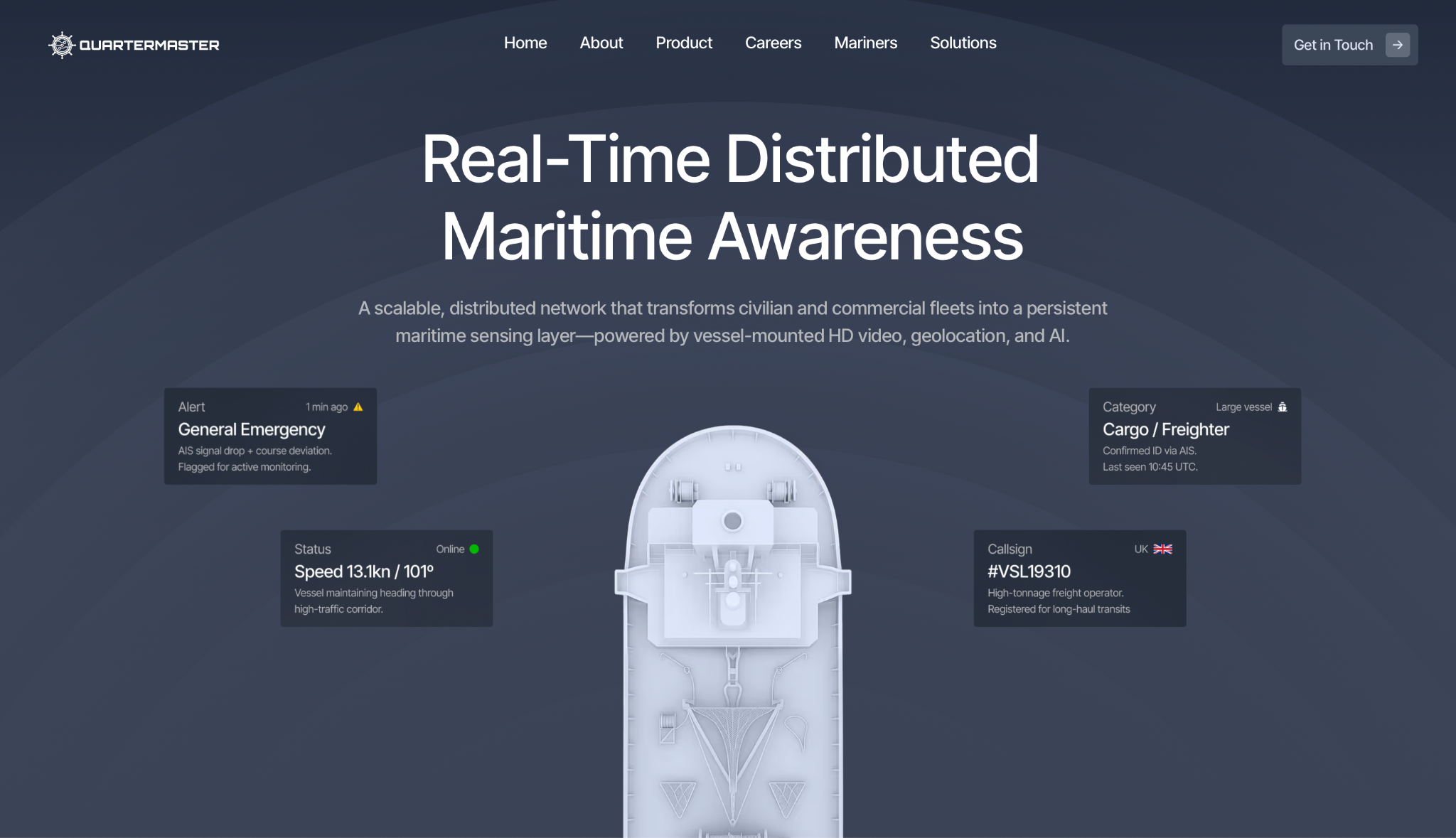
Company Overview: Quartermaster is building the world’s largest maritime awareness network. Founded by Neil Sobin, formerly defense deployment lead at Scale AI, Quartermaster uses video capture, location authentication, sensors, and artificial intelligence to provide unprecedented visibility across the world’s oceans. Their product is known as “SmartMast” and it is far more advanced than AIS, the current industry standard. The company announced their $43M Series A last week, co-led by First Round and Quiet Capital, with participation from BoxGroup and TMV Logistics.
Founders: Neil Sobin - founder and CEO of Quartermaster, UChicago graduate, former Scale AI Defense Deployment Lead
Investors: First Round, Quiet Capital
Amount Raised: $45M+
Headquarters: Alexandria, VA
Hanover Park
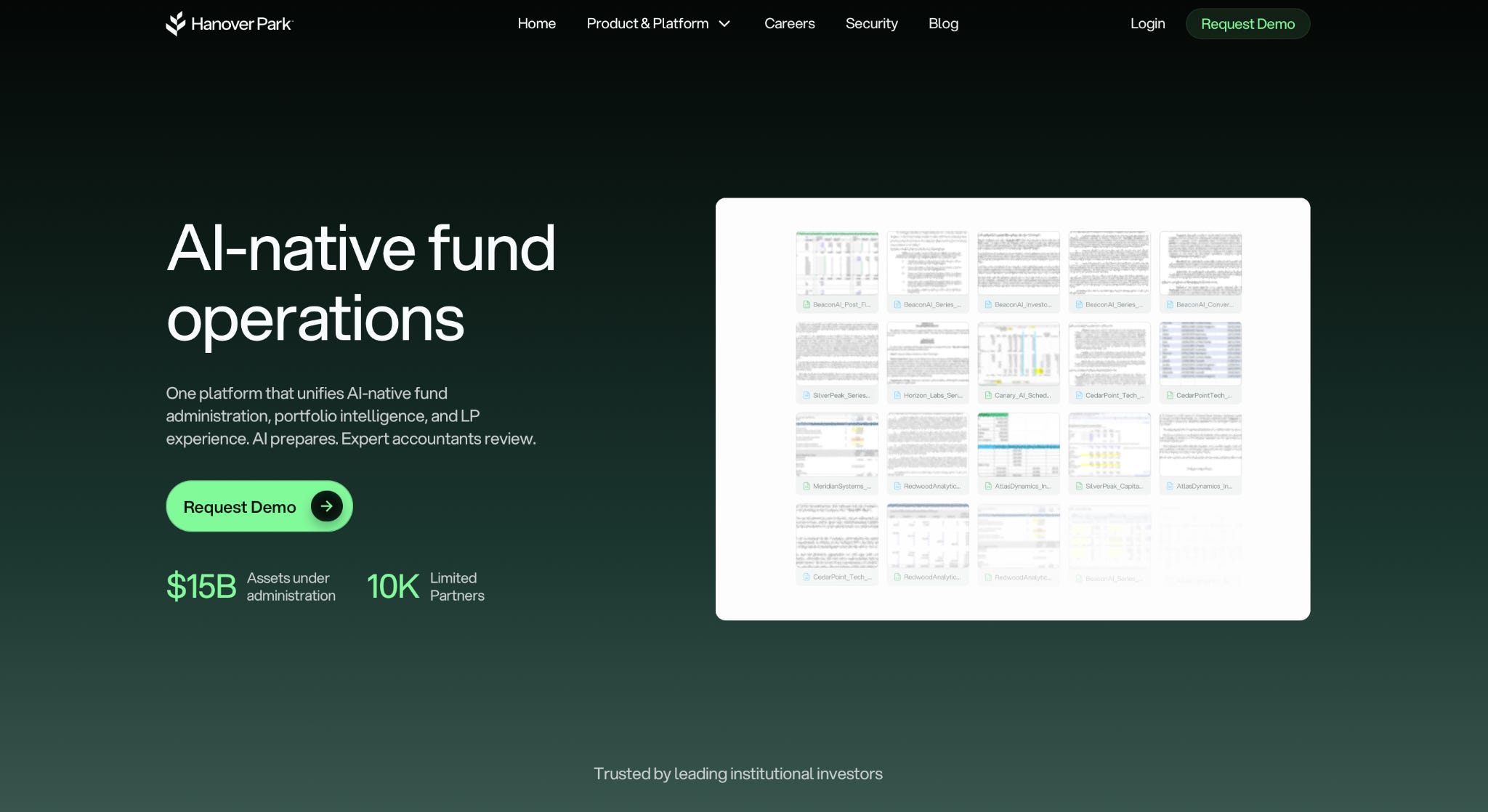
Company Overview: Hanover Park is the leading AI-native fund operations platform. Hanover leverages technology to handle back office operations efficiently for mid to large venture capital and private equity funds. The company recently crossed $15B AUA and their last fundraise was a $27M Series A round from Emergence Capital with participation from Lux, announced in March 2026.
Founders: Chris Hladczuk - co-founder and CEO of Hanover Park, Yale graduate, former Goldman Sachs investment banker, former CRO at Meow; Nick Puljic - co-founder and CTO of Hanover Park, Columbia graduate, former SWE at Oscar Health, former YC W22 founder
Investors: Emergence Capital
Amount Raised: $31M+
Headquarters: New York, NY
Accordance
Company Overview: Accordance is developing software that helps tax professionals do their jobs better. The software is trained on public tax data and also learns from customers’ own financial histories. Companies like Figma and Quora use Accordance. Khosla, General Catalyst, NEA, Sequoia, and Anthropic all participated in their $13 million seed raise.
Founders: David Yue - co-founder and CEO at Accordance, Stanford dropout; Finsam Samson - co-founder and CTO at Accordance, Stanford dropout
Investors: Khosla, General Catalyst
Amount Raised: $16M+
Headquarters: San Francisco, CA