Upon This Rock
plaid over stripes.

What would change the game more, making the hoop 12 feet or removing the 3 point line?
On its face, the question is ostensibly a thought provoking question. However, once pondering for more than 30 seconds, the correct answer becomes clear.
If the height increases from 10 to 12 feet, there would be some friction and shooting percentages would decrease across the board in the short term. However, one can credibly argue that over time, it would gradually approach previous percentages until settling, if not at, close to normal marks.
On the other hand, if the three point line faded away, everything about the way basketball is played would drastically change.
The Duncan Robinsons and Sam Merrills of the world would likely fade into obscurity, as the expected PPP (points per possession) on their 28 footers would fall off a cliff, falling from roughly 1.2 to .8. Thus, the current hunt for 3 point specialists would likely move towards seeking the next paint dominating big man.
In an alternate universe, Hunter Dickinson finishes his NBA career as one of the all-time greats.
Between the changes in scouting, analytics, coaching style, assortment of the five players on the court, and even the positioning, it’s safe to say that the game would change dramatically. The difference between this scenario and the previous one is that these changes would be permanent, whereas changing the goal height would provide an immediate negative shock to offensive output but would slowly creep back to normalcy.
But of course, this is exploring a hypothetical world, and as we know, the real basketball world we live in revolves around the three point arc.
The first thought is to discuss Steph Curry’s impact on the game and analyze how the implementation of the 3 point arc facilitated his ascent to top-10 of all-time status. But the ramifications are much wider than that. Along with the increased pace, the shift towards increasing the proportion of 3s shot has allowed an entire generation of players to place themselves in a pristine position to surpass their idols in a very pertinent category: total points scored. Furthermore, the earlier in their careers when the analytics revolution occurred, the more they stand to benefit.
Let’s take two high scoring young players as examples: Jayson Tatum and Anthony Edwards. If we assume a constant scoring output over their careers, an 18-year career, and roughly 70 games played, they are projected to score 34K and 32.6K points respectively, landing them in the top 10 very comfortably, with Tatum being on the cusp of top five. The flimsiest assumption is likely an 18-year career, and while it is difficult to predict a player’s career length, an entire generation of stars from the 2010s are still playing and seem to have plenty of gas in the tank. Steph Curry, Russell Westbrook, Kevin Durant, James Harden, and Demar DeRozan are just a few examples of older players that have silently put together lengthy careers of 15-18 years who don’t get enough recognition for it simply because LeBron James is still one of the best players in the league in his 23rd season.

So as the game has shifted more towards the three and pace increases, getting to 30 on any given night has become easier; and even if one argues that the difference is marginal, marginal differences compounded over time expand into wide gaps. Thus for the current game, the 3 pointer has become the foundation, making the game simpler, smoother, and more enjoyable for the end consumer.
Plaid is the 3 point line for financial technology.
Plaid functions as the connection later between the ever increasing number of consumer fintech companies and the bank data needed to use the apps, essentially serving as the underlying foundation of these apps. While retrieving consumers’ bank data seems easy enough, without Plaid, developers found the task rigorous because the data wasn’t aggregated and different banks used different systems. Thus, Plaid does all of the dirty work through using its API to unify all of the different bank data into one format through a process that includes aggregating, categorizing, and standardizing the data. Their real advantage lies not from being able to do this with the largest players but having the coverage to do this process with all of the smaller, less notable regional banks as well.
Interestingly enough, building the backend for consumer fintech companies was not the original plan for Zach Perret and Will Hockey. In their eyes, the biggest and most notable tech companies at the time were consumer facing, so it only made sense to start in this lane.
Perret studied hard sciences at Duke, earning a BS while being heavily involved in campus leadership and student government before working at Bain for a short stint. While he was there, he met Hockey, a computer science grad from Emory, and although neither of them had a traditional finance background, they immediately bonded over a common theme: the outdated nature of financial infrastructure.
The initial concept was some form of a financial budgeting application, as after they left college and entered the real world, they realized how opaque something as simple as paying your bills could be. But Perret quickly ran into two problems. The first was rather simple: while people theoretically wanted to save money through budgeting and smarter spending, Perret concluded that practically speaking when it came to actually doing it, most people didn’t actually want to. More importantly, he also experienced firsthand just how difficult it was to build custom integrations for different financial institutions, so they realized that building the API that would simplify that process could have a higher expected value of success than another consumer fintech app. Because they were building a consumer app, the ideal situation is to spend a majority of the time figuring out ways to onboard customers and then continuously curate the product to retain them, but this wasn’t the case at all. They were spending so much time and effort trying to access the data required that they couldn’t onboard customers at the rate they wanted to. To make the decision even easier, they showed the head of engineering at Venmo their app and he told them the consumer-facing aspect “sucked,” but he wanted to license their backend and would pay for it.
This was all the validation they needed to go all in on the infrastructure play.
An important piece of context to paint the picture was the recent establishment of the Dodd Frank regulation after the Great Financial Crisis. All you need to know about Dodd Frank is any story about the glory days of Wall Street from the typical managing director always starts with a reminiscent sigh and “you see, back in my day before Dodd Frank…”

In addition to a wide variety of new rules that Wall Street now had to play by, the most pertinent change that directly impacted Plaid was the mandate that consumers could access their financial data at any time. The only problem was that it wasn’t actually clear on how exactly this would happen mainly because it still needed to be interpreted and clarified by the newly minted Consumer Financial Protection Bureau. Because of this, most of the banks held off on building APIs to retrieve consumers’ financial data, which ultimately meant that in order to make the data retrieval process work, Plaid would have to “screen scrape,” manually logging in to consumers’ accounts as a bot and essentially pretend it was the consumer himself logging in. Banks also didn’t go out of their way to build APIs because they initially weren’t fans of the fintech space in general. The tale of the hostility from the old, established titan towards the ascending newcomer is one as old as time, and this is exactly the lens through which the banking system viewed fintech. The perfect example was the antipathy towards Robinhood, as the free commission platform, while not making a major dent, was “stealing” just enough order flow from the incumbents to become annoying. Knowing this friction existed, there needed to be serious growth for the banks to take the newcomers serious, because when this happened, they would have to capitulate and either build the APIs or have Plaid do the job for them.
It is safe to say that the ecosystem did in fact grow, ushering in the golden age of consumer fintech. The growth of Plaid was directly tied to the growth of the ecosystem as a whole, as the company not only depended on more players entering the space but also existing members onboarding new customers. The growth of both led to Plaid crossing 10 million consumer account connections in 2017 and north of 20 million by the following year. By the end of 2019, it had integrated data from more than 11,000 financial institutions and over 5,000 fintech apps were using the product. An important part of the GTM was “selling through the basement,” known as identifying lower level developers and creating a smooth, frictionless experience for them and hoping they would advocate the product to the rest of the organization. Plaid’s business model consisted of a stable “per user per month” fee as well as “per action” fees that includes every time initial signups or payments occur.
After similarly impressive growth numbers in 2019, 2020 started off with a surprise: a $5B acquisition offer from Visa.
The story played out exactly how every startup imagines: experience a problem first hand, build a product or a service to combat it, experience exponential growth for several years, and then smoothly sail into the liquidation event where the founders, employees, and investors all strike it rich.
Visa had been an investor in the company, mainly because they really weren’t a direct competitor; Plaid had no interest in issuing any sort of card to eat into Visa’s market share, so the partnership had been purely synergistic.
Over the next few months, the requisite paperwork was slowly being completed with an interesting twist in the fine print: a “pandemic clause” that ensured that even in the case of a potential pandemic, Visa would still be obligated to go through with the deal.
Before accusing Perret and Hockey of being a part of the secret cabal that rules the world and orchestrates future global events, it is safe to say that there were enough murmurs about a potential pandemic even in January of 2020 that it made sense to include this possibility.
Because of this clause, Plaid had optionality in the deal which proved to be critical.
Firstly, the deal was looking even more appetizing from Plaid’s perspective because as soon as the pandemic hit and stock prices crashed, the percentage ownership of Visa Plaid shareholders would get dramatically increased. The deal was majority cash but included a stock component that was dollar denominated; because the dollar amount remained fixed, as the stock price decreased, the more shares those same dollars would amount to.
Before the excitement could grow too large in the Plaid offices, there was another twist: the DOJ stepped in and requested for the transaction to be reviewed by the FTC for a potential antitrust violation. This wasn’t necessarily a big deal initially, as most deals over a certain nominal amount will typically get flagged with an initial request, but what was unexpected was the second request, which signaled that this one was more serious than normal.
As the year went on, the process became more and more drawn out, and it became clear that this lawsuit could last all of 2021 as well. This scenario was less than ideal for Plaid, mainly because their company was exploding during the COVID era, as multiple tailwinds were hitting their business at once. Firstly, not only were financial assets booming due to the free money flowing through the financial environment but also people had free time to finally learn about what stocks and crypto were and why they were booming. Additionally, the near zero rates not only meant surging asset prices but more directly gargantuan amounts of funding for fintech startups, providing an incentive for more of them to pop up and immediately use Plaid to link accounts.
Thus, as the company began growing and the valuation multiples continued to expand, the $5B valuation price that was agreed upon began to become more of a call option for Visa that would undeniably be a bargain if it was exercised. Luckily, there was another clause in the contract that stated if a year passed after the initial agreement, Plaid could walk away from the deal.
While they would eventually leave the deal on the table, it wasn’t as much of a no-brainer as it would seem mainly because the expectation of both employees and investors was that they were going to liquidate their positions and buy the dream house overlooking the Bay that they had been dreaming about for years. As Perret expected, when he announced over Zoom that the deal was not going through, many employees were not particularly happy. However, to lighten them up, he ensured that a fraction of people’s positions could be liquidated through secondaries, so instead of a full cash out for the new crib, everyone would have to settle for a Tesla Model S Performance.
And maybe a Model Y if you were a young buck.
Three months later after walking away from the deal, the company raised at a $13B valuation, executing on the secondaries promise through this fundraising cycle.
Interestingly enough, when the deal was initially being negotiated with Visa, the CEO of Intuit at the time gave him a call and told him congratulations on achieving the pinnacle of success for a first time founder. Before hanging up, he left Perret with an interesting caveat: even if it doesn’t go through, things are going to turn out great as well.
Almost like he knew the deal would fall through.
As mentioned earlier, working with banks and fintech companies meant that Plaid was very much tied to the broader financial macro environment, which was a major boost in the early days after the COVID breakout.
Thus, they were tied to the finance macro for better and for worse.
When rates quickly increased in 2022, Plaid experienced real adversity for the first time in a while, as although they were still able to maintain positive growth, the rate of growth slowed quickly. Their revenue from the per user per month and per payment remained relatively stable, but the top line from new sign ups took a nosedive. In theory, people should actually flock to consumer fintech apps when prices drop to acquire assets for pennies on the dollar, but reality is far from theory and the herd behavior is of course to sell. They maintained the slower growth phase up until roughly Q3 of 2023, where they saw growth approach normal levels.
One positive from those slower growth years was the focus on growing additional products outside of their main “Link” service. The common denominator among these new products is the vast amounts and variety of data they come across, with the two most notable being fraud detection and credit scoring.
Plaid can easily monitor activity through different apps, so they quickly realized their customers would pay for early fraud detection based on suspicious activity not only within their apps but other apps as well. Additionally, FICO has been using much of the same data and systems since the 80s and 90s, but Plaid’s access to personal financial data far surpasses it. FICO doesn’t include other information like new raises or higher paying roles, spending levels, or other secondary pieces of information that helps paint a more holistic picture of someone’s creditworthiness in real time.
Sometimes, Plaid will act as temporary contractors, doing a variety of different tasks for their customers because as soon as a company would try to build a certain product, they would simply ask Plaid to do it for them due to Plaid’s unique access to such a large quantity of data.
Thus, building the infrastructure for these different products in these slower growth years allowed these new products to account for roughly 1/5 of the company’s ARR in 2024. In a world where companies are constantly engaging in side quests that prove to be epic failures and only result in millions, if not billions, of dollars wasted, this is a massive feat for Plaid.
More growth. More products. Stronger business.
Yet, a lower valuation.
Significantly lower.
In 2025, Plaid raised $575M at a $6.1B valuation, seemingly contradicting the idea that their business has massively grown in quantity and quality.
Before the haters begin to chirp, Perret insists this cut in valuation is simply due to compression in multiples, as the previous round was raised in 2021, also known as the year of free money. While the valuation drop-off is not ideal, it was still a good signal to see most of their existing investors re-up during this round, as they likely viewed the valuation as a bargain. Rather than being a sign of internal weakness, the discount is rather an opportunity for Perret to go back to the drawing board and plan the company’s next steps.
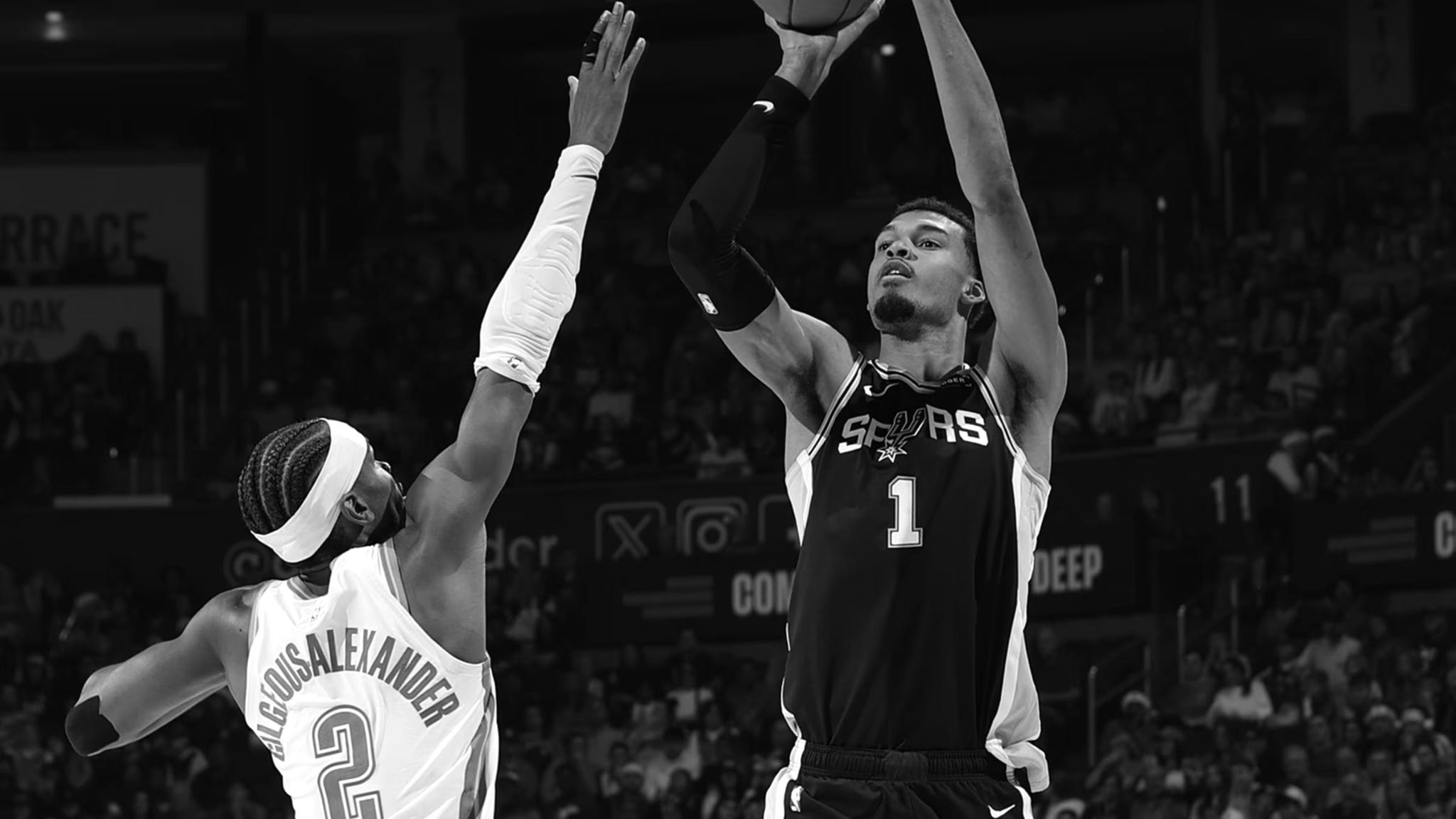
Speaking of returning to the drawing board, many teams are thinking about doing something similar. With the advent of the Steph Curry revolution and the ensuing Warriors dynasty paired with the Boston Celtics’ 2024 championship run, the consensus around front offices quickly became to shoot as many 3s as possible. However, with the recent success of the Oklahoma City Thunder and the ascending San Antonio Spurs, a new philosophy could be on the horizon, as both teams are built in a similar fashion: a clear number 1 and 2 option that catalyze the bulk of the offensive creation and a wide array of defensive talent, particularly at the wing spot that have the defensive versatility to match up with guards, wings, and even smaller bigs. Neither team crack the top 10 in 3 pointers attempted (#13 and #14 respectively) but both are in the top 3 in defensive efficiency. The New York Knicks–whom many are labeling as the third best team in the playoffs–also land outside of the top 10 in 3s attempted and are top 5 in points allowed. This is not to say that the 3 pointer’s role within the game is going anywhere; it is the rock that the game is built upon and to strip the game of its foundation would be too drastic of a change that would likely negatively impact all of the constituents within the game. However, the spray and pray model of the early 2020s may be shifting, and the magnitude of the shift will depend on the success of the two 60-win Western Conference behemoths.
Let the new age rivalry begin.