
The Space In Between
An injury took away my entire senior season. It also gave me the space to discover venture capital.
By Chisom Okpara. Edited by Allen Lee.

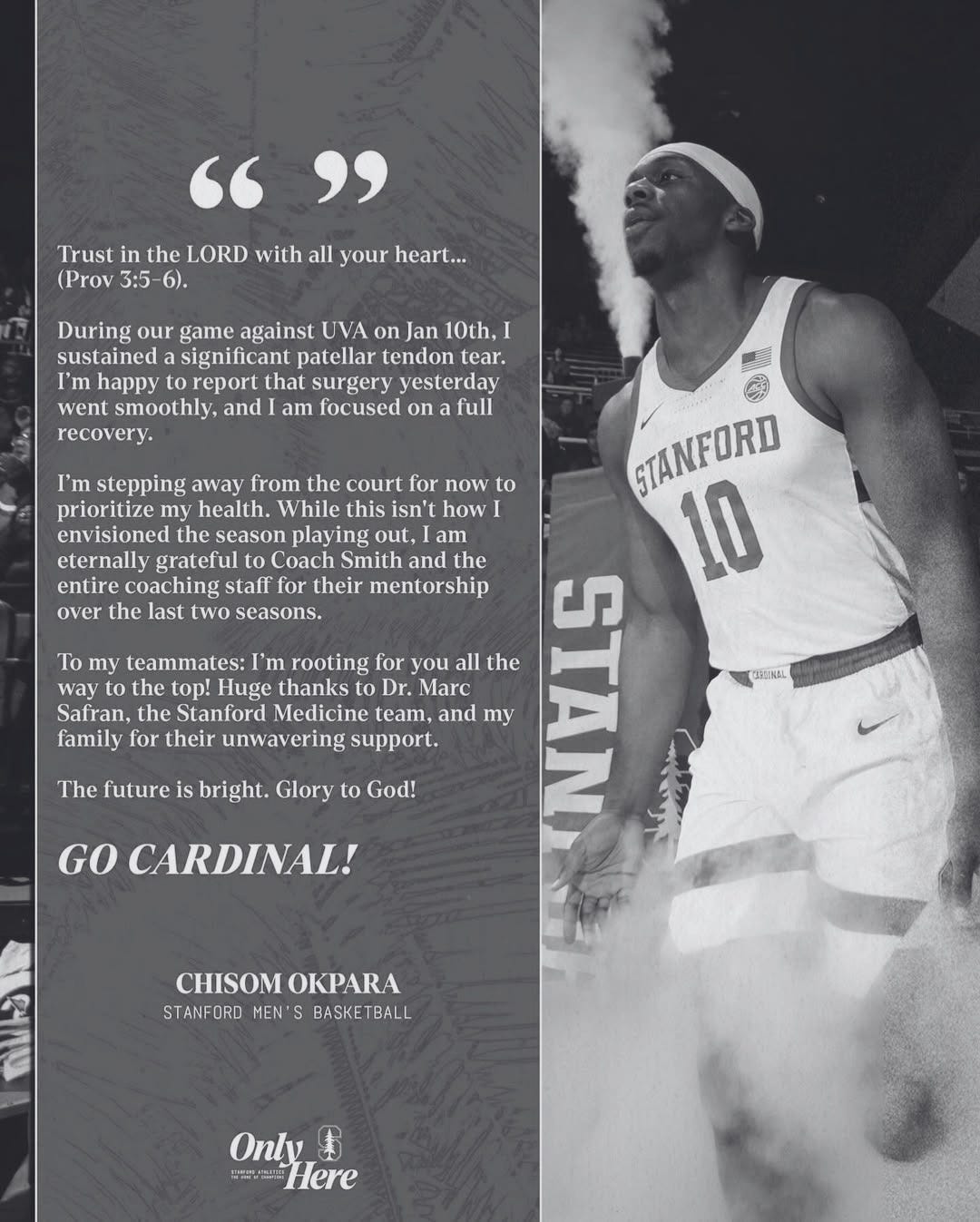
I drove the lane at UVA and at the last second pulled it back to kick it out.
I don’t even remember the pass. But I remember the landing.
I felt a pain so loud it drowned everything else out. I couldn’t bend my knee. I couldn’t think. Then came the fear and panic - the kind that hits before your brain catches up.
Three days later, I was back at practice, moving slowly, with no idea what the MRI would say. Then Dr. Safran called and pulled me in.
“Patellar tendon, more than 50% torn. You’re done for the season.”
Just like that, my senior season was over. I walked into practice thinking I was managing an injury. I walked out knowing my year was gone.
What I didn’t know yet was that those few seconds at UVA were about to give me something I never really had before…
Time.
I’m four months out from surgery now - rehab twice a day, every day. But the space in between is where this whole other life has been quietly taking shape.
I’ve always known I wanted to invest in early-stage startups. Turns out, my injury moved up the timeline.
To date, I’ve met with more than 30 VC investors. I wrote my first check into an early-stage sportstech startup. And I’m building a network that’s growing faster than I can keep up with.
I’m still new at this. I’m still learning. But I’ve been getting reps in.
And for any athlete sitting on the same itch I had, wondering whether there’s actually a path into the VC world, here’s what I’ve learned so far.
Pattern Recognition Comes From Getting Your Reps In
Judgment in early-stage investing is a muscle. And like any muscle, it gets built through volume.
One piece of advice I keep hearing from veterans in the space is this: if you want to develop an eye for great startups, you need to see a massive number of deals. Take multiple founder meetings a day. Study the original pitch decks of companies that ended up becoming huge.
This feels like familiar territory, because it’s the same thing I’ve been doing my whole life. You take hundreds of shots until the motion becomes automatic. You practice alone in an empty gym so that when the buzzer’s about to go off and the lights are on you, your body already knows what to do.
Early-stage investing works the same way. You sit in enough founder meetings and eventually your brain starts picking things up - which founders have what it takes, which problems are real, and which market opportunities feel inevitable.
There’s no shortcut to pattern recognition.
VC is a Relationship Business
The best investors operate as nodes in a highly trusted network.
From the outside, this industry can look cold, cutthroat, and closed off. But once I started getting inside the rooms, it felt surprisingly relational.
I’ve had countless meetings where the next steps rarely involve anything transactional. Sometimes, one conversation turns into another introduction, then another. Over time, those relationships started opening doors I never would’ve found on my own.
One of those introductions led me to Eric Chen at OVO Fund, which eventually led to me writing my first check into a startup called The Intelligent Search Company.
VC is a relationship business. Being welcomed into the industry requires proving you can built trust. Once you have it, the industry becomes far more collaborative than people realize.
Skate to Where the Puck Will Be
After studying the history of VC, I realized that a lot of alpha comes from looking past the current hype cycle.
It’s important to become an expert in something that’ll be hot in five years. Hardware. Engineered biology. Whatever the next thing is. Build expertise in that space before it goes mainstream.
This is challenging but also exciting. It forces a different kind of patience. It demands a shift from reacting to what everyone is currently talking about to figuring out what they will be talking about.
Puneet Agarwal at True Ventures talked about a similar idea through the lens of contrarian thinking: some of the best founders can see something the market hasn’t fully priced in yet. Because by the time everyone agrees a sector is hot, most of the alpha is already gone.
This is probably the lesson that’s hardest for me to put into practice right now. I’m still figuring out which sectors are worth going deep on. But I know that’s the right question to be sitting with.
At the Earliest Stages, You’re Investing in the Founder
This has been the single biggest mindset shift for me.
At the pre-seed and seed stage, you’re not investing in a product. You’re investing in a founder’s character and their sheer force of will. The product is probably going to pivot 25 times before it finds product-market fit, and the only thing that survives all those pivots is the person at the top.
Charles Hudson from Precursor Ventures shared one of the clearest frameworks I’ve heard for evaluating founders. He focuses on three things:
Market knowledge: do they actually understand the space they’re in?
Their “why”: is there a real, personal reason they’re building this?
Unfair insight: do they know something the market doesn’t yet?
Steve Bowsher also introduced me to the idea of the “personality thermometer”. When he evaluates founders, he’s not just listening to the pitch - he’s reading the room. The presence. The composure. The way they handle pushback.
And separately, he looks for evidence of excellence in any domain. It could be previous jobs, athletics, music, anything. Because winners tend to keep winning. The arena changes, but the underlying traits often transfer.
A lot of these conversations ended up shaping the lens I used when I eventually wrote my first check.
Conviction Comes From Stacking Signals
Here’s the thing nobody tells you about writing your first check: you’re not waiting for one big “yes” moment. You’re stacking smaller moments of conviction until the answer starts to feel obvious.
I learned this writing my first check into Pick and Roll AI, the first product developed by The Intelligent Search Company. The platform uses AI to help basketball programs evaluate players, organize scouting information, and make smarter recruiting and transfer portal decisions.
Looking back, I can map exactly what stacked up.
First, the opportunity came through a warm introduction from, Eric Chen, someone I trust and continue to learn from. And when I saw other investors I respected getting involved too, it created another layer of validation. Their conviction didn’t replace my own thinking, but it gave me confidence the opportunity was worth taking seriously.
Second, I realized I had a form of unfair insight that a lot of people on the cap table probably didn’t. The transfer portal is chaotic. Coaches are overwhelmed with film and scouting reports. I’ve lived inside that world. I know what coaches are looking for. I know what players care about. I know how fragmented the process feels from both sides. Pick and Roll AI was solving a very specific and real problem.
Third, the founders, Arpan and Moe clearly knew the space. But what stood out even more was how they responded to pushback. The second I challenged something, they leaned in instead of shutting down. They had a combination of knowledge and humility, which left a real impression on me.
None of those things alone would’ve been enough signals.
And even after all that, it still feels scary having put capital behind an idea that’s still early. But I think that’s part of the game. Conviction doesn’t mean certainty. It just means you’ve done enough work to believe.

I’m four months in and one check deep. A lot of what I’m operating on is still instinct. And the more reps I get, the more I realize instinct is just a starting point.
I’m still building my own thesis, and that’s going to take time.
But I’ve realized that the same things that made me a basketball player - discipline, coachability, obsession with reps, comfort with being uncomfortable - are the exact same things the VC world rewards.
Lately, people keep asking me how I balance chasing the NBA while building something off the court.
Truth is, there are 24 hours in a day, and basketball is non-negotiable. But there are still hours left in the day. And I wanted to spend them building something that could grow alongside basketball, not after it.
Investing hasn’t taken anything away from basketball. If anything, it raises the stakes in a way that makes me want it more. The better I perform on the court, the more access I have, the more doors stay open, the more opportunities I get to learn from incredible people.
The two worlds feed each other.
Rehab has a way of slowing everything down.
Every morning, I wake up and rebuild the knee a little more.
And somewhere between the film sessions, founder calls, weight room, and rehab table, I realized I’ve been building something else too.
Chisom

Chisom Okpara is a NCAA Division I basketball player at Stanford. Alongside his pursuit of professional basketball, he spends his time investing in early-stage startups. To keep up with Chisom, follow him on LinkedIn and Instagram.
Check out more stories here:


