
The New School.
could've bought stock in cursor before it was cursor, for like two million.
Cursor owes its success to Steph Curry.
Jalen Suggs dribbled down the lane, slowing down for just a second on the fastbreak to load up for a dunk. As he approached the rim, he accelerated then twisted his body in the air for a 360 slam. Now it was Chet’s turn. The gangly seven footer brought the ball down the court with his right hand, stopped just in front of a much smaller Steph Curry, went behind the back to his left, then quickly behind his back again to his right, beating Curry off the dribble and coming down the lane with momentum. Help defense was useless at this point, and Chet swooped in for a two handed dunk, landing on the floor instead of his feet. The clips of Steph and Chet going back and forth went viral that summer.
At the time, Chet and Jalen were just high school standouts proud to share a court with Steph at his annual Curry Camp. The program is an invite-only event that showcases the best high school players in the nation before they become superstars at the college and NBA levels. In past years, Anthony Edwards, Cade Cunningham, Cooper Flagg, AJ Dybantsa, Dylan Harper, Stephon Castle, Amen Thompson, Ausar Thompson, Jared McCain, and Jalen Green have all participated at the camp as high school prospects. In some sense, getting an invitation to Curry’s summer sessions is harder to do than making a McDonald’s All-American game. Curry invites 16 boys and 16 girls, across multiple classes of high school, while the McDonald’s All-American game consists of 48 players, all seniors, half boys and half girls. No other basketball program, be it Nike EYBL or even Team USA National Teams, can truly rival the talent density that Curry puts together each summer. If you want to watch a future NBA all-star in person, this is the place to be.
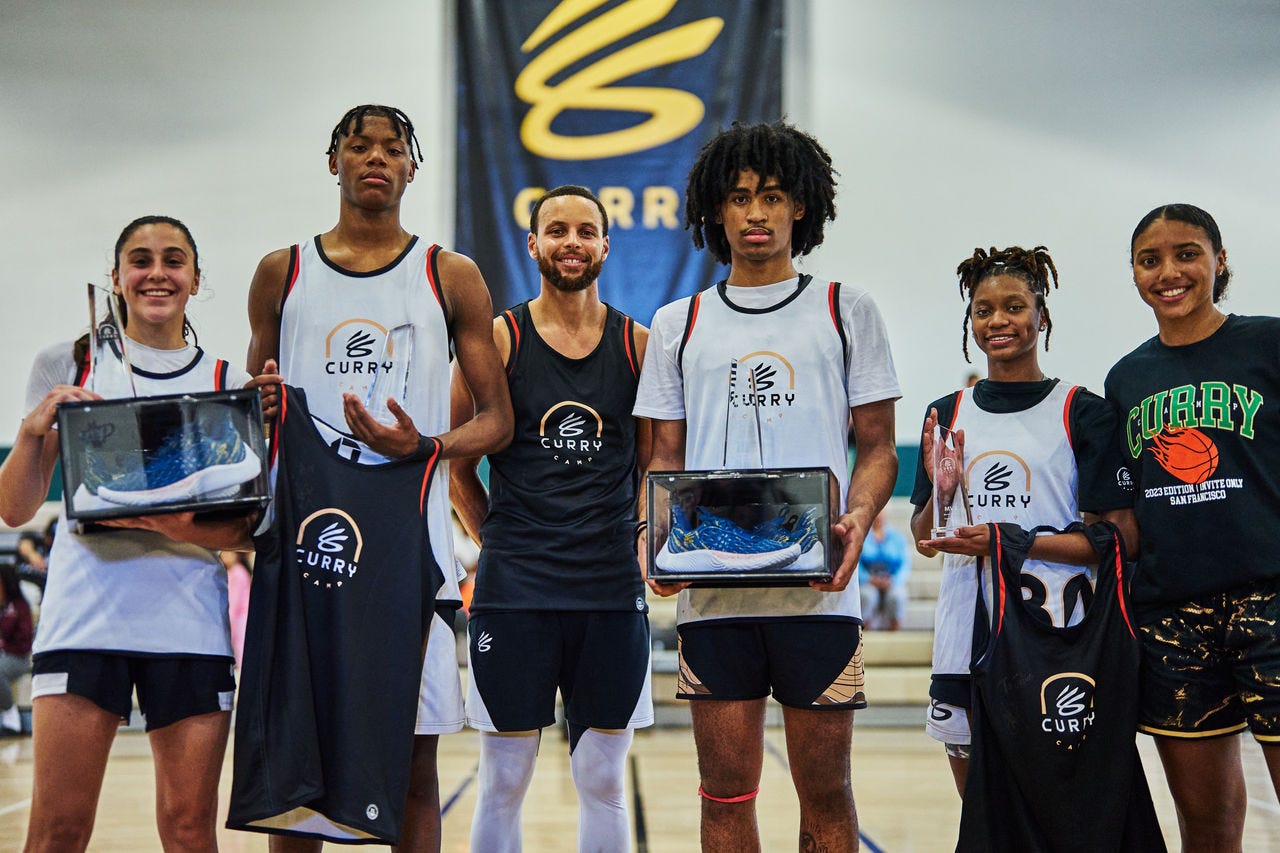
The program originally launched in 2014 as the SC30 Select Camp. The first few years were nothing to write home about, but the time spent built a foundation that would serve future generations. In 2016, Steph Curry was socializing at a cocktail party at SF’s City Hall, when he found himself talking to a technology entrepreneur about basketball talent networks. The tech executive, Ali Partovi, was actually attending on behalf of his twin brother Hadi, who missed the event due to a flight delay. Ali talked about how scouting for basketball was similar to scouting for software engineers, but basketball had robust talent discovery networks like Nike EYBL, endless high school camps, Team USA, etc., while the tech scene lacked depth. Ali had been thinking about starting a talent network-investment fund hybrid for years before that conversation, but he didn’t have the courage to do it himself. Steph said he was interested in learning more, and the next day, Ali began a ten year journey to construct the Curry Camp for technical talent.
Cursor’s 25-year-old CEO just inked a $60 billion deal with SpaceX.
In perhaps one of the most interesting deals of the year, SpaceX agreed to either acquire Cursor for $60 billion or pay the company $10 billion for their work together. Both outcomes ensure that Cursor does very well as a company in the near term, and by extension, provides their investors with generous security. Before the Musk stimulus package, Cursor was slowly losing steam to Anthropic’s Claude Code, and the business’s unit economics were in a state of flux. Since Cursor was using other artificial intelligence models to power their AI coding tool, they were subject to the foundation models from a pricing perspective. Anthropic could, relatively speaking, afford to serve consumers at more competitive rates since they owned the technology. Cursor was renting the technology and was losing money as users spent more time and compute on the platform. The media narrative pre-SpaceX deal was “Cursor’s dead.” The media narrative before that was “Cursor is the greatest of all time:” the company went from $0 to $100 million of annualized recurring revenue in twelve months and sent the venture capital ecosystem into a frenzy. Prominent partners at top firms started appearing on podcasts and saying things like “going from $1 to $3 to $9 million is not interesting (anymore). You have to go $1 to $15 to $100 million.” The Cursor cap table is a who’s who of growth equity: Thrive, a16z, Coatue, Accel, DST. Some of these funds stand to generate respectable multiples should the $60 billion buyout go through. Yet no one stands to benefit as much as Michael Truell.
Truell attended Horace Mann, a prestigious New York prep school, then MIT, where he completed a summer internship at Google. During his summer internship in 2018, Michael met Ali Partovi, a former technology founder who was now recruiting star engineers for the second cohort of his pre-accelerator program. Ali was captivated by Michael, who completed a coding test in record time. Ali admitted Michael to the program and vowed to invest in any company Michael founded. Three years later, Ali Partovi was the first investor in Cursor. The rest is history.
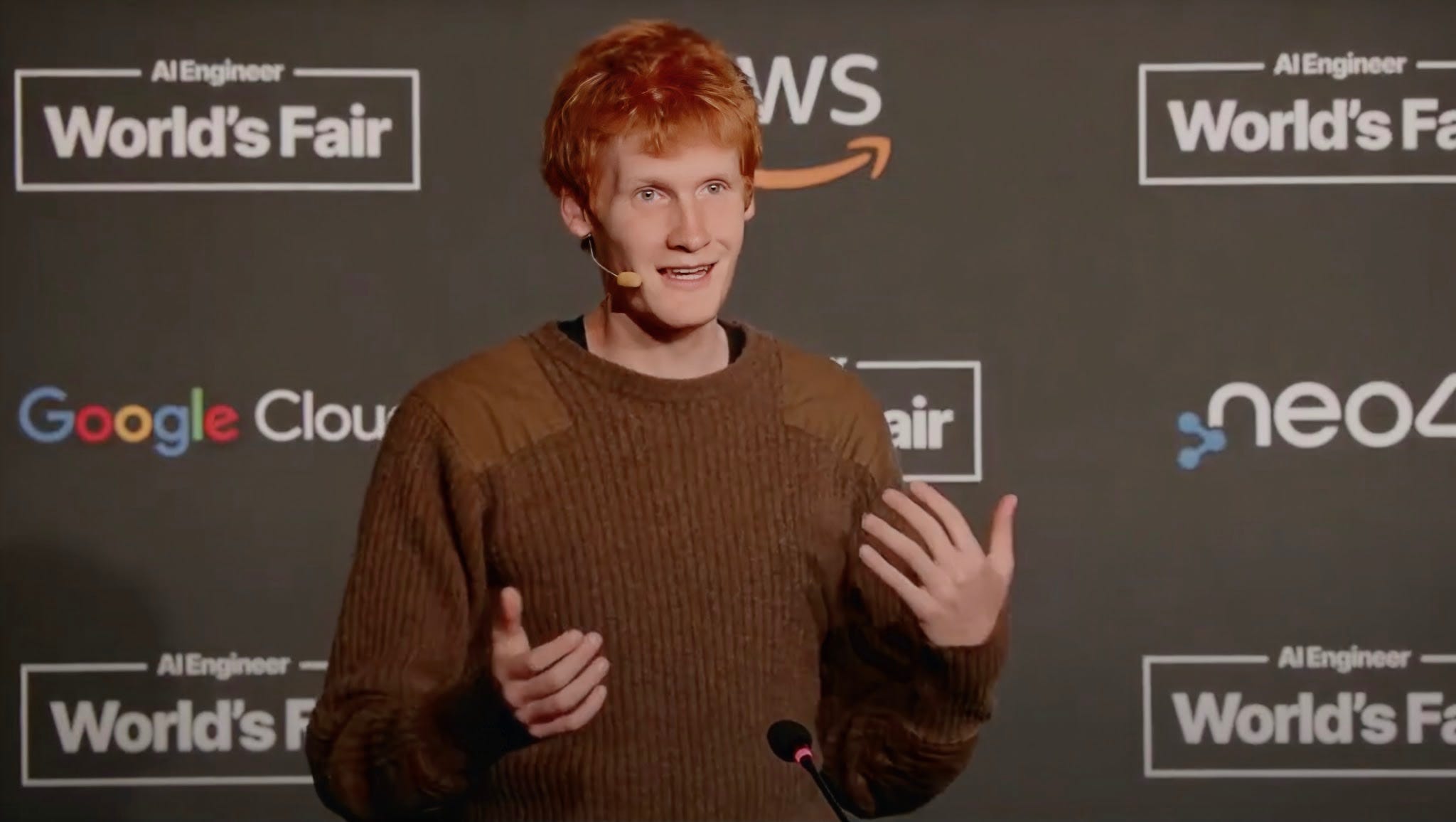
New eras usher in new models for educating the youth. Most Ivy League institutions were created for the purpose of training religious clergymen: Harvard and Yale trained Congregational clergymen; Princeton trained Presbyterians; Brown was for the Baptists; Columbia was the Anglican response to the growing influence of Protestantism. As the country underwent societal shifts (Civil War, industrialization, a rise in popularity of the German education model), colleges evolved into secular academic grounds circa 1850. Latin, Greek, and Christian theology took the backseat to medicine, law, and science.
The most interesting educational trend in this day and age is the accelerator model. Y-Combinator has grown from a Cambridge summer program to funding more than 600 new startups every year, and a significant proportion of those founders are too young to buy liquor. UC Berkeley, Cornell, MIT, and Stanford watch dozens of students take leaves of absence each year to try and raise millions in funding at YC. No other accelerator has their reach: 5,400+ companies funded including Stripe, Airbnb, Coinbase, Doordash, Reddit, and Twitch. When you talk about startup schools, you have to mention Y-Combinator.
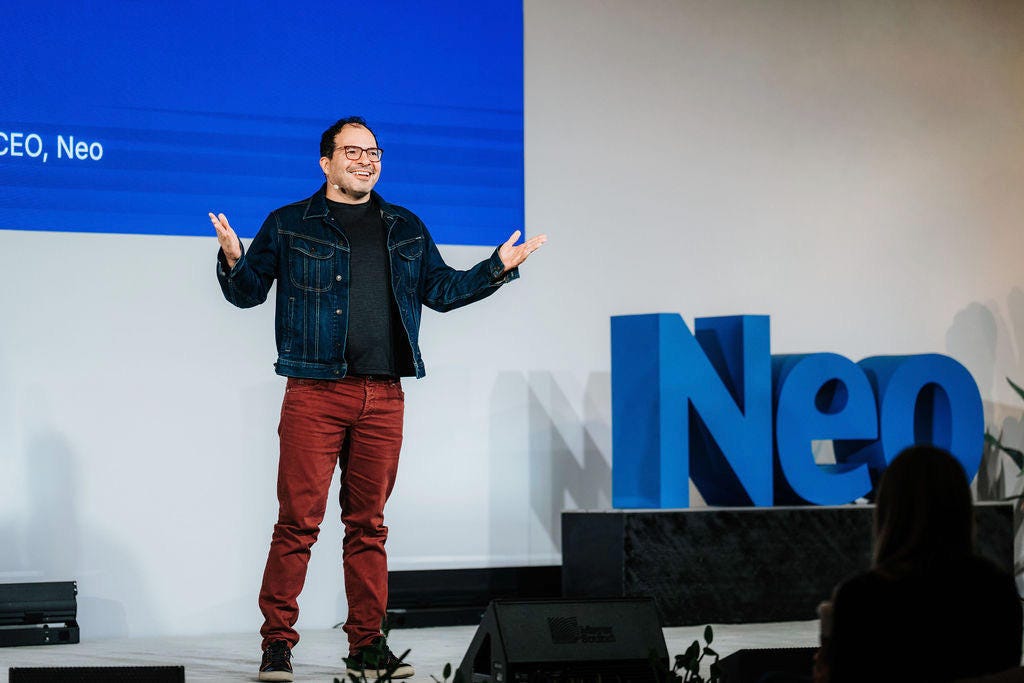
Partovi studied at Harvard alongside now Sequoia partner Alfred Lin. He understood if Y-Combinator was already the fun, successful state school, he needed to come up with a new school, a smaller, private Ivy League for the most technically gifted young startup founders. He named it Neo.
Neo is a Greek derivative that means “new,” also short for neophyte, a beginner or rookie, typically used in fraternities or secret societies. And, by no coincidence, Neo is the main character in The Matrix series, played by Keanu Reaves. Ali is training the next generation of world shapers.
Neo vs. Y-Combinator:
Selection Criteria:
Neo: two pathways, Neo Scholars and Neo Residency. The Neo Scholars program accepts roughly 25 highly technical students (~2% acceptance rate) into a year-long program of events and mentorship to accelerate their careers as founders. Scholars also get acceptance into the Residency, Neo’s Y-Combinator competitor that selects 15-20 startups per year (~1% acceptance rate) and gives them $750,000 on an uncapped SAFE, much better economics than Y-Combinator.
Y-Combinator: 150+ companies per cohort, with four cohorts a year. $125,000 for 7% of the company, with an additional $375,000 at whatever valuation the next round is raised at. Incentivizes YC founders to maximize their seed valuations in order to prevent additional early dilution.
Notable Alumni:
Neo: Cursor ($30B private val.), Cognition ($26B private val.), Kalshi ($22B private val.), Chai Discovery ($1.3B private val.), Applied Compute ($1.3B private val.)
Y-Combinator: Stripe ($159B private val.), Airbnb ($80B market cap), Doordash ($69B market cap), Coinbase ($45B market cap), Reddit ($27B market cap), Kalshi ($22B private val.), Deel ($17B private val.)
Returns:
Neo: Neo 1.0, the 2018 vintage fund, is at a 7.5x net MOIC while Neo 2.0, a 2021 vintage, is at a 6.5x net MOIC, according to a profile in the Wall Street Journal. The two funds turned a combined $150 million into $1.2 billion, top-tier returns especially during a tough 2021 vintage; safely top 1% funds performance wise. The smaller cohort sizes have worked in their favor, as Y-Combinator is deploying capital into 20x the amount of companies and needs both more frequent and larger winners to match their top of class returns.
Y-Combinator: harder to piece together as they have not been as transparent with their results. Historically, the camp has released data snippets showing that Y-Combinator is “the best asset class in venture” and consistently top quartile. Safe to assume their returns are very respectable but nowhere near Neo’s recent success. Y-Combinator also has significantly higher AUM.
Steph never invested in Neo after indicating interest in doing so, and by extension, missed Cursor as well.
But the brief moment of validation was enough to motivate Ali to get started.
In a decade, he’s built a small educational institution with a venture arm, visible only to certain students on certain campuses. Across the past three cohorts of Neo Scholars, 82 students were accepted (~27 each year on average), with just three colleges accounting for almost half of all Neo Scholars. Harvard has sent 14 students to the Neo program over the past three years, while Stanford has sent 13, and MIT has sent 10. Other schools consistently represented across cohorts include the University of Michigan (6), Yale (5), Columbia (4), UC Berkeley (3), and UPenn (3). As mentioned earlier, only students with extraordinary levels of computer science aptitude are encouraged to apply; a rigorous coding test weeds out the ordinary folk before an interview is even granted. Which means, most students are simply not interested in the program to begin with. Ali’s training lab is underground, out of sight, out of mind, with no plans to eventually become as mainstream as Y-Combinator. He only wants to find the next Tarek Mansour before Kalshi, the next Michael Truell before Cursor, the next Russell Kaplan before Cognition. If just one scholar in every few cohorts can break the matrix, then maybe, just maybe, Ali can rest easy knowing the next fund will generate a tenfold return on capital.