
Today’s memo is brought to you by Caplight.

We recently inked an exclusive partnership with Caplight - read the press release here.
Caplight puts VC data and deal flow in one place.
The best venture investors in the world use Caplight to track private company valuations and fundraising activity, and to trade the private markets.
Book a demo here.
In January 2025, Colossal Biosciences raised $200M at a $10.2B valuation.
The Series C funding round was led by TWG Global, a holding company founded by Mark Walter, the CEO of Guggenheim Partners, owner of the LA Lakers, and owner of the LA Dodgers. TWG Global’s other chairman is Thomas Tull, the former CEO of Legendary Entertainment, the media company that produced 300, The Dark Knight, Inception, and Watchmen.
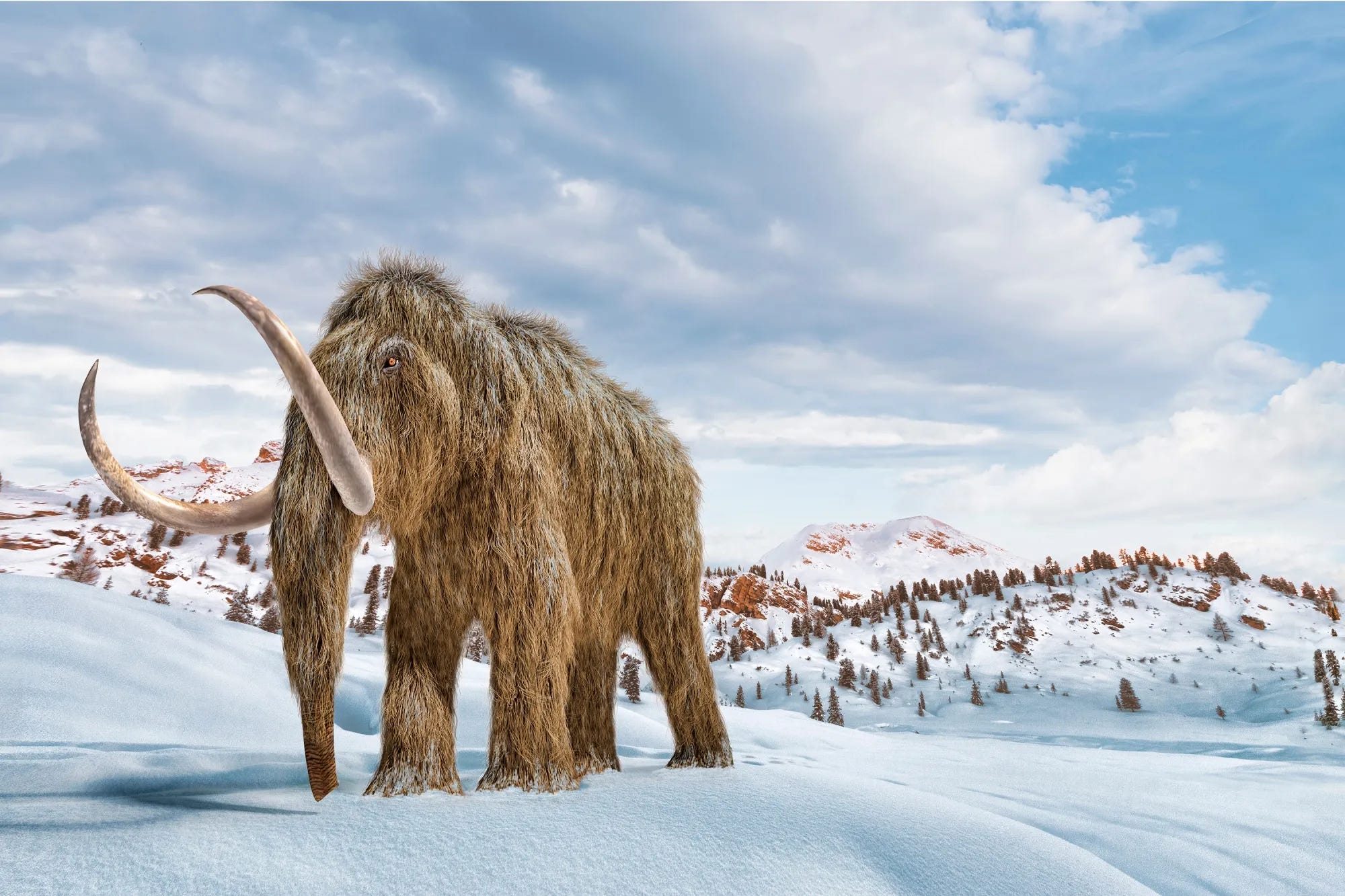
Colossal is a deeptech science company focused on using genetic engineering and computational biology to bring back extinct species like the woolly mammoth and the dodo bird.
Their business model is not to make money from de-extinction, but rather to make money by licensing the technology that powers de-extinction and selling it to governments (In-Q-Tel, the CIA’s venture arm, is a Colossal investor) and other deep pocketed entities. Colossal claims their gene editing and artificial womb tech will have applications in fertility, agriculture, and conservation, with a serviceable addressable market north of $40B. Translating the research breakthroughs to commercial success, however, is a gargantuan task, and while some of the scientific accomplishments have been impressive, the monetization has been lackluster. Colossal is in a crowded field, with competitors like Synthetic Genomics, Illumina, Mammoth Biosciences, Twist Bioscience, Inscripta, and Synthego, to name a few. They are all vying for a piece of the same pie.
The company’s expenses are also significant, roughly $19M per month as of earlier in 2025 - this number could have increased or decreased since - meaning that a $200M raise will buy less than a year’s worth of runway. This explains why Colossal raised an additional $120M in September 2025. The company’s largest expense is paying salaries for researchers; around 180+ scientists are making ~$700,000 each year, on average. Additionally, Colossal does not project significant revenue until 2027, when the first enterprise sales from livestock genetics are projected to bring in $15M.
Looking at comparable companies is when investor irrationality for Colossal becomes crystal clear. Ginkgo Bioworks Holdings is an American biotech company founded by MIT scientists, and they use genetic engineering to produce bacteria with industrial applications. The company’s valuation peaked in the frothy 2021 market, going public via SPAC at a $17.5B valuation before slowly coming back to the ground: ~$3B (end of 2023), ~1.6B (early 2025), and now under $500M after losing a major customer. But zooming in on Gingko’s valuation earlier this year, the company was doing $400M in revenue when it was valued at $1.6B. Another comparable: Zymergen, a biotech company that combined genomics with machine learning to engineer microbes for manufacturing, went bankrupt after a peak $3.2B valuation. No matter how you cut it, the $10.3B current valuation for Colossal is a suspicious price to pay.
Their strategy seems to be more media-centric rather than focused on fundamental top-line growth. If we can capture the imagination of the general population by storytelling, we can go public at a favorable valuation, and then we can find a way to win through consolidation, maybe eventually we figure out how to commercialize to the tune of $1B+ in revenue. This would explain why Colossal’s list of investors looks more like the guest list of an Oscars afterparty than a biotech syndicate. Paris Hilton, Tom Brady, Seth Green, Chris Hemsworth, Tony Robbins, Tiger Woods, George R.R. Martin (Game of Thrones creator), and for good measure, former Disney exec Kevin Mayer and former HBO Chief Content Officer Kevin Reilly as advisors. Per the company’s own website, “Investors of Colossal - which launched three years ago - include a who’s who of sports and entertainment.” This is equal parts a biotech business and blockbuster trilogy that early investors hope retail investors will pay to watch. Perhaps more parts the latter.
The company recently made its first acquisition, buying a pet cloning company called Viagen around three weeks ago. Financial terms of the acquisition were not disclosed. Viagen has been around since 2002 and has exclusive licensing to the technology from Roslin Institute that cloned Dolly the Sheep. Naturally, Colossal wanted to tap into their roster of celebrity investors and get the media excited about the acquisition’s potential. So Tom Brady used Colossal’s technology to clone his dead dog. It’s easy to get caught up in the enticing debate of whether or not people think it’s cool to clone your dead pets - but stay with me. The important part about this announcement is to watch whether or not Viagen’s top line gets a lift from the Colossal media engine. Cloning a dog or cat through the Colossal subsidiary costs $50,000 while a larger animal like a horse will cost $85,000. Time will tell whether Viagen can improve the near term financial forecast for Colossal, but my intuition tells me Americans don’t want to clone their pets, even if the world’s greatest quarterback tells them to.

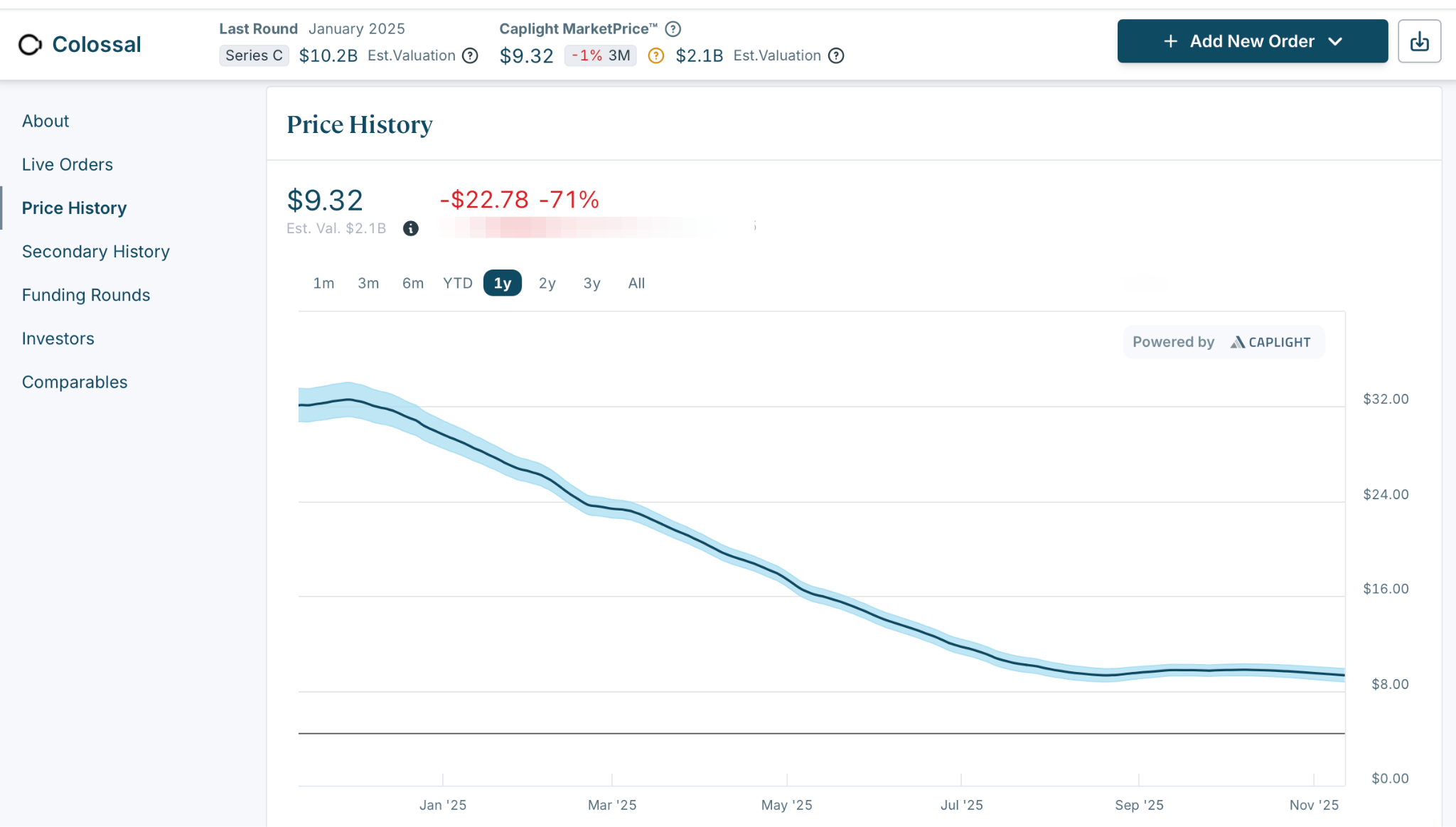
The secondary market for Colossal equity validates the bear case thesis. Institutional investors are generally not excited about Colossal at a $10B price point, and pressure from shareholders trying to sell at lower valuations is driving the secondary market price downwards. Caplight’s MarketPrice hovers around the $9 range, indicating an estimated valuation of $2.1B, even though the company was able to raise another $120M at a $10.3B valuation. Perhaps I’m a bit biased here, but Colossal’s bear case is Caplight’s bull case. Clear data is the electrical current that will help turn the lights on in private markets. Caplight’s data can bring truth to TechCrunch announcements crowning decacorns that no one - except a lead investor - is willing to touch at that price point. There is not a single investor in the secondary market expressing buy interest in Colossal; to say the company is worth $10B because two entities are willing to pay that price is absurd. On the other hand, you have existing investors praying someone answers their call to sell shares, even if it’s at a 70%+ discount. The vast disconnect between what a few bullish investors are willing to pay and what other market participants are willing to pay is here to stay as more companies avoid the reality check of an IPO. This is why there is still so much room for innovation in private markets.
The reason Colossal was able to bag a $10B valuation is quite simple: all of their rounds post-seed stage have been led by the same people.
The Series A round was led by Thomas Tull.
The Series B round was led by USIT (Thomas Tull is a founder and chairman of USIT).
The Series C round was led by TWG (Thomas Tull is a chairman).
Please ask yourself why a media mogul who brought The Dark Knight and Inception to life is the main investor behind a biotech company. Or better yet, ask why they couldn’t get a single deeptech investor to co-lead.
Colossal’s cap table is circular.
This is, by no stretch of the imagination, an argument saying Colossal is a bad company. That’s not true. The startup has done plenty of groundbreaking research and is pushing the limits of synthetic biology. George Church is arguably the best founder to take on this vision. In the 1980s, he developed the first direct genomic sequencing method, which laid the foundation for modern high-throughput sequencing. He also helped pioneer the Human Genome Project, something I vaguely remember learning about in AP Biology. His work on CRISPR technology at Harvard won enough accolades to last a lifetime, and Church is generally thought of as one of the top geneticists alive. Storytelling is also important, and trying to capture the public’s imagination like Apple or SpaceX did could pay off in the long term. And, to be clear, there is a non-zero chance that Colossal makes a miracle discovery and also successfully commercializes to the $1B+ realm, in which case, the $10B price tag would be attractive.
With that being said, Colossal is a highly questionable investment at $10B.
I’m not sure there are many serious buyers that love this bet.
The Wonderful World of Secondaries
Mercor
Most Recent Fundraising Round: $350M Series C / October 2025
Most Recent Valuation: $10B
Caplight MarketPrice: $10.4B (+6% in last 3mo)
Ramp
Most Recent Fundraising Round: $300M Series E+ / November 2025
Most Recent Valuation: $32B
Caplight MarketPrice: $31.4B (+51% in last 3mo)
OpenAI
Most Recent Fundraising Round: ~$40B Growth / October 2025
Most Recent Valuation: $500B
Caplight MarketPrice: $516.6B (+13% in last 3mo)