Good Credit
the remorse.
Caravaggio was a sick man.
The Baroque artist’s name paid generous homage to his Renaissance predecessor: Michelangelo Merisi da Caravaggio.
In the recesses of his heart lived two wolves, one a belligerent murderer and the other an artistic genius.
By artistic genius, I mean the best in the world during his time.
And by belligerent murderer, I mean a man who killed people when he got angry.
Around 1591, Caravaggio committed a murder that forced him to flee Milan and find a new life in Venice, then Rome.
In 1605, Caravaggio injured a notary with his sword during a dispute over a woman.
In 1606, Caravaggio killed Ranuccio Tomassoni during a fight in Rome. Tomassoni was a gangster from a wealthy family, who, like many others that frequented the streets at the time, had his fair share of run-ins with Caravaggio before. This time was different. Tomassoni, a rich man and citizen of Rome, was dead. Previously, Caravaggio could rely on one of his powerful patrons to protect him from the law’s strong arm of justice. His most notable backer was Cardinal Francesco Maria del Monte, a high ranking Bishop with a love of art. But Cardinal Francesco Maria could not save him this time; Tomassoni’s family wanted his blood spilled in retribution. So Caravaggio was sentenced to beheading, and the authorities placed an open bounty, allowing any civilian who saw him to dismember his head from his body and get paid in the process.
Caravaggio fled Rome in a hurry.
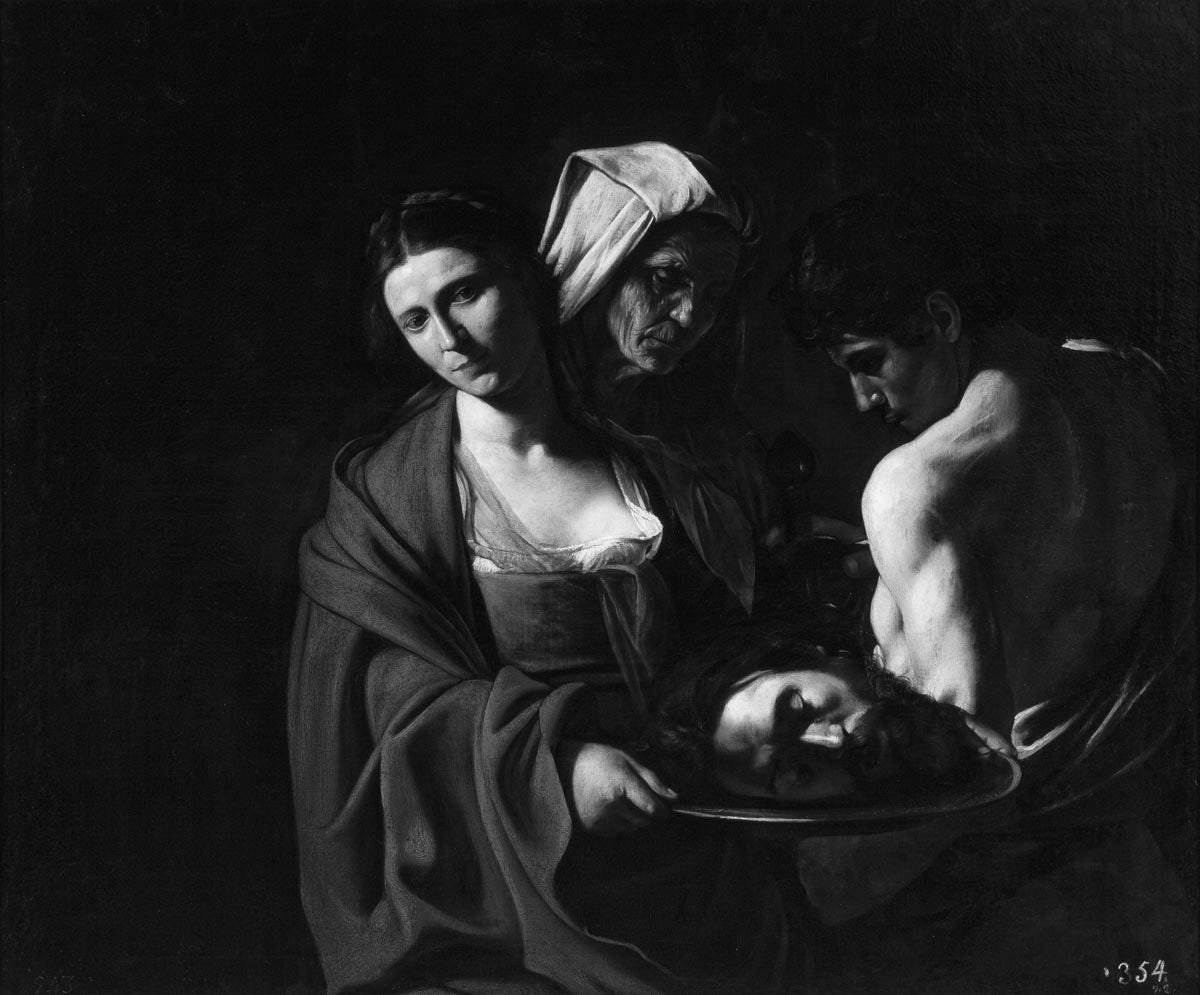
He spent the next four years in exile, bouncing between Naples, Malta, and Sicily. During this time, Caravaggio’s remorse began to leak onto his canvas. He painted a number of works revolving around the themes of beheading, Christian mercy, and forgiveness, including The Beheading of Saint John, The Seven Works of Mercy, The Raising of Lazarus, and Salome with the Head of John the Baptist.
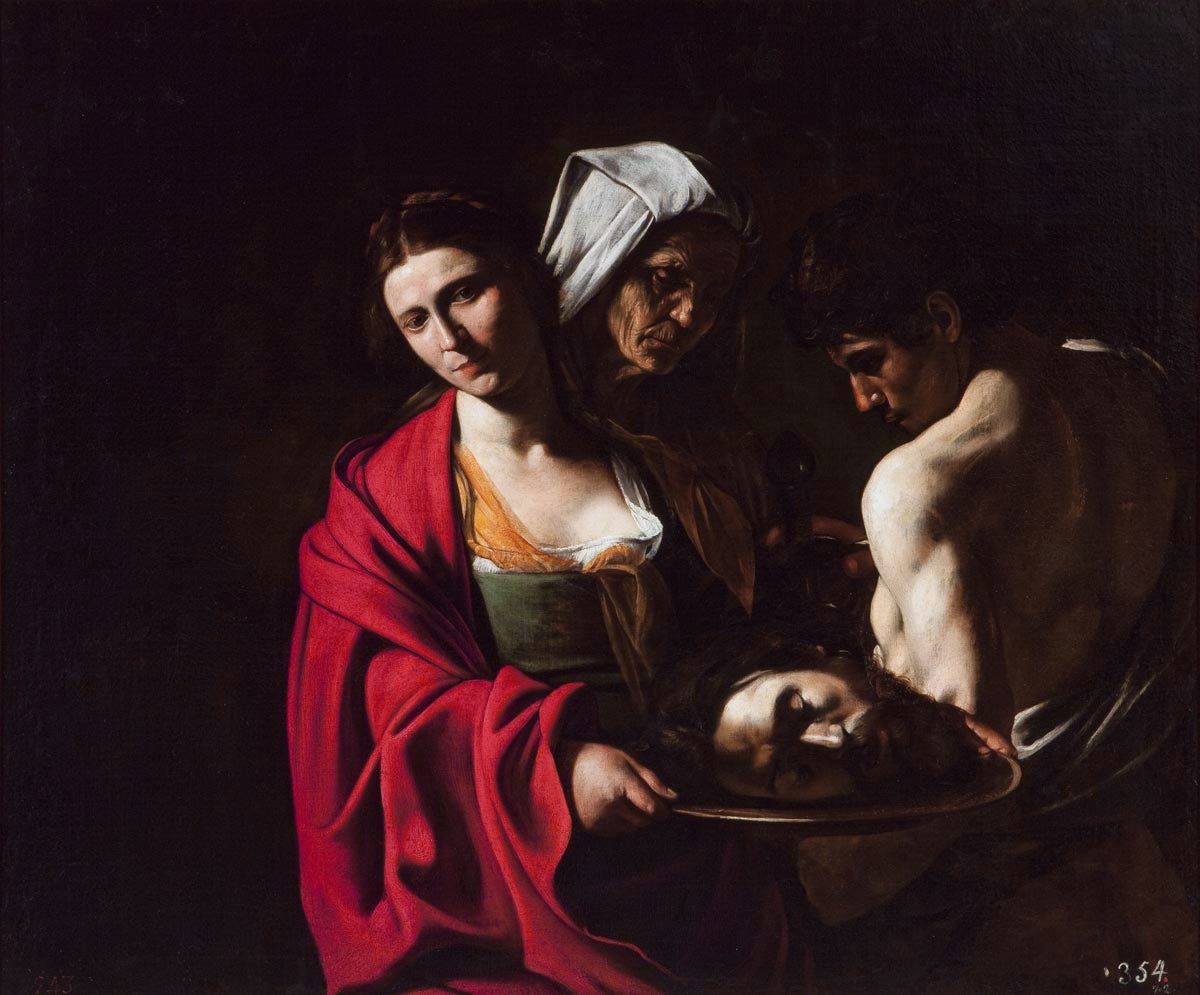
Salome with the Head of John the Baptist depicts the Biblical story where Salome, the daughter of Herodias and stepdaughter of King Herod, dances for Herod and his guests, and after pleasing the King and his company, gains his favor. Herod then tells Salome to ask for anything and he will make it so, and Salome, at the instruction of her mother, asks for John the Baptist’s head on a platter. At the time, John the Baptist, Jesus Christ’s older cousin, was the most renowned prophet in Judea, and it hurt even Herod’s hardened heart to order death to a righteous man. In Caravaggio’s masterpiece, he illustrated his own head as a model for John the Baptist; an aesthetic plea for mercy from the law. Then he sent it to authorities in Malta.
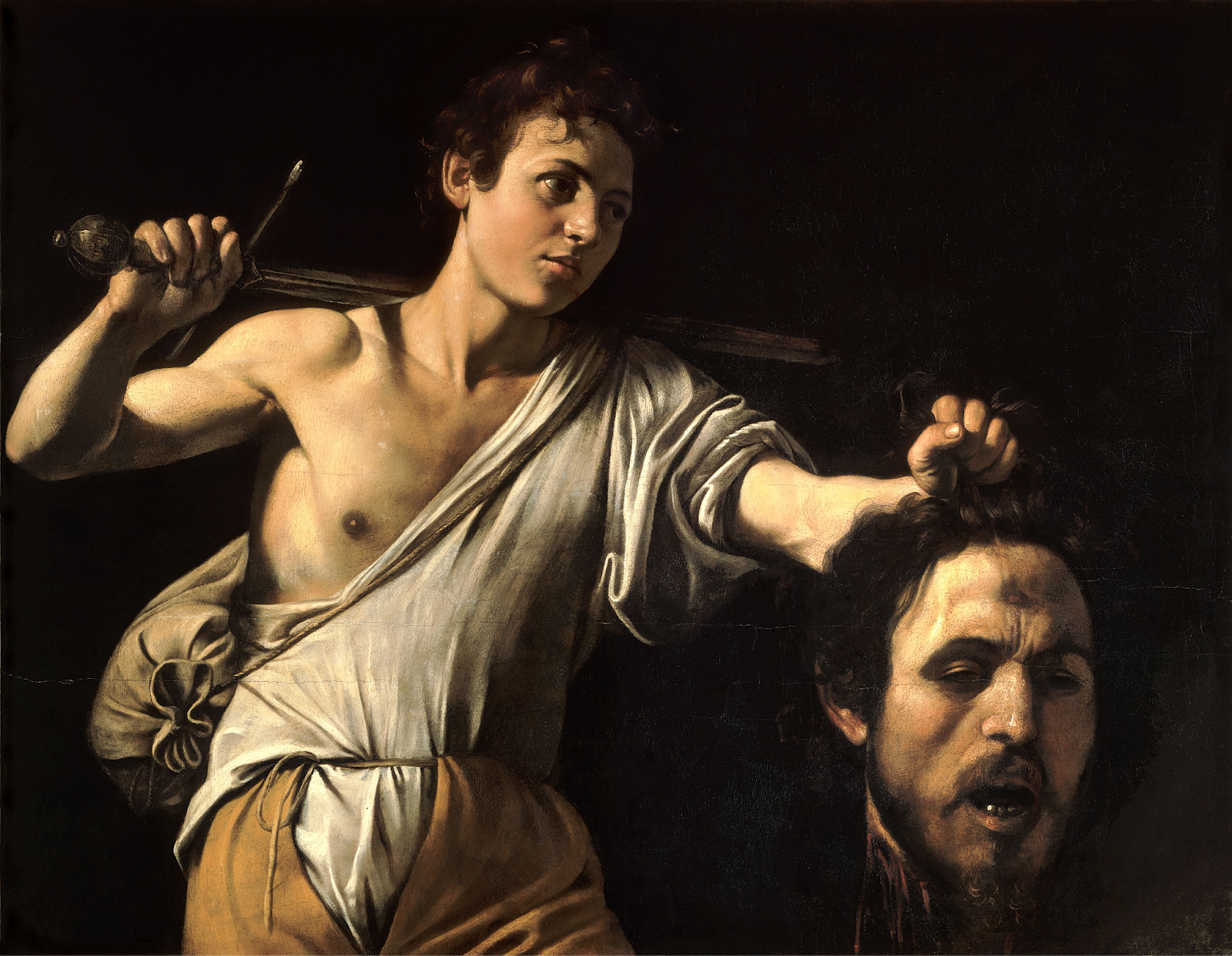
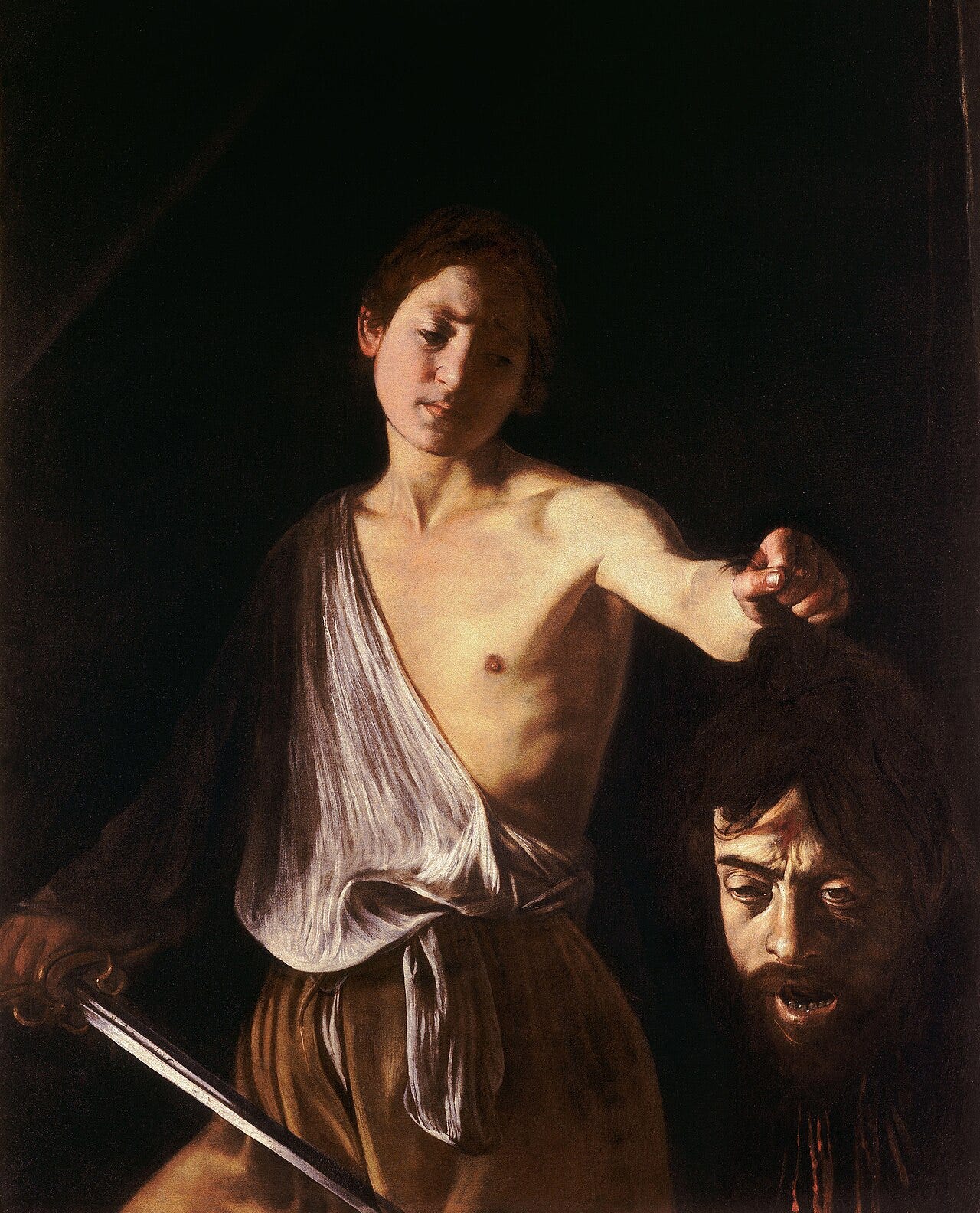
On the run for his life, Caravaggio created some of his best work. It was around the same time as the Salome painting that he painted David with the Head of Goliath, an unusual take on the classic scene. Instead of David basking in the glory of God-given victory over Goliath, the young to-be-king of Judah is sorrowfully staring at the giant’s dismembered head with remorse. Onlookers can barely make out the letters H-AS OS on David’s sword; a Latin inscription short for humilitas occidit superbiam, first coined by Saint Augustine around 400 AD. Humility kills pride. Goliath’s head of course, was modeled by Caravaggio’s own. He sent it to a Cardinal in Rome, and upon seeing the masterwork, authorities decided to remove the bounty from Caravaggio’s head. In 1610, he took a boat ride back to Rome to receive his pardon.
He never made it back.
No one really knows how he died. The most likely explanation is that he got sick with a fever or malaria. Rumor had it that the Tomassoni family caught up to him. What is known, however, is that, when it mattered most, Caravaggio painted with a strong mixture of passion and repentance in a fight to regain his life. The artistic genius sought to create a visual pleasure so powerful that it would remedy any pain caused by the belligerent murderer. And it worked briefly. But the murderer had sown too many seeds this time.
He was buried off the coast of Tuscany, in Central Italy, a fitting resting place for the greatest Baroque painter ever.
Tuscany is roughly 400 miles north of southern Italy.
In the 1880s, more than 300,000 Italians immigrated to the United States.
In the 1890s, this number doubled to 600,000.
In the 1900s, more than 2,000,000.
The migrants largely consisted of young Italian men who sought to earn money in America and then return home. They came from the northern and central parts of Italy prior to 1900, but after 1900, southern parts dominated the Italian exodus to America. Sicily, Calabria, and Campania were a few of the regions in the south that Italians left from. New York, Boston, and Philadelphia were the primary cities they planted roots in.
South Philadelphia was an especially Italian area, overwhelmingly filled with immigrants from Calabria and Campania.
This is where Frank Quattrone grew up.
In 1955, Quattrone was born. His mother, Rose, was a sewing machine operator that quit her job at his birth, and his father, Frank, was a presser in a tailor shop who became a union official. Both were of Italian descent; Quattrone’s grandmother was an immigrant from southern Italy in the early 1900s. The Quattrone family lived paycheck to paycheck.
Frank’s elementary school, Stella Maris, was attached to their local Catholic church, which bore the same name. 98% of the parishioners were Italian at the time. From a young age, Frank was known for his intelligence. As a first grader, he read at a fifth grade level, and when he got old enough, Frank was awarded a scholarship to St. Joseph’s Prep, a boy’s high school in north Philadelphia, where he grew in popularity due to a combination of book smarts, aggression, and quick wit.
He would go on to attend Wharton on a full scholarship. At graduation in 1977, Frank was one of three students to join Morgan Stanley full-time. The firm was even more prestigious at the time than it is today. The young swashbuckler from 9th and Shunk made it to the top of Wall Street, scoring $12,500 a year in the process. After his two year analyst stint, Frank went out west for a Stanford MBA. The immersion in Silicon Valley opened his eyes to the potential of new technology. One of his classmates, Steve Ballmer, dropped out to launch a company called Microsoft with an old acquaintance. When the MBA program reached a conclusion, Morgan Stanley told Frank to come back out east to New York. He refused. Instead, Morgan Stanley ought to come out west, because his wife, Denise, was doing a two year program at a San Jose hospital, and there were opportunities in the Bay Area the firm should explore. Morgan Stanley’s recruiters did not actually believe a junior associate would risk his offer over a wife’s job, so Quattrone doubled down, bought a house in the Bay, and started interviewing with local firms, just to show he was serious. Morgan Stanley folded like a lawn chair at a South Philly cookout. In 1981, Quattrone re-joined Morgan Stanley, working from a satellite office in San Francisco alongside Carter McClelland, the more senior banker that persuaded him to attend Stanford. Quattrone’s pay leveled up to $35,000.
For a few years, things moved slow. Quattrone was a technology banker, and the technology industry was nascent. Morgan Stanley did not care about Quattrone’s deals because the IPOs were tiny tech companies going public at $100 million valuations. The $1-2 million fees were pitiful compared to the RJR Nabisco deal where Morgan Stanley earned $25 million. Bankers at firm headquarters in New York thought Frank was deranged.
As life would have it, a little less than a decade later, the technology financing space started to grow into a full-fledged industry. In the early 90s, Frank reached $1,000,000 in annual compensation, and by 1995, this number ballooned to $6,000,000. His pay only captured a small portion of the economics: Morgan Stanley sold $203 million of technology IPOs in 1990, compared to $5.8 billion of technology IPOs in 1995, a nearly 30x increase. Morgan Stanley’s technology group became the fastest growing business line for their investment banking division, and it was effectively operating as a wholly separate company, from the other side of America, subject to the whims of Mr. Frank Quattrone.
But Morgan Stanley was a white-shoe firm with complex politics. Technology was still not a prestigious industry to cover, and Quattrone quickly got the sense that his success was not being appreciated to the fullest extent. The story of a high performer feeling underpaid is as old as time itself, and in 1996, the union had run its course. Quattrone would go on to join Deutsche Bank, where he hoped for the “flexibility and autonomy to make decisions and build the technology dream team.”
The dream team would last less than two full basketball seasons, and in 1998, Quattrone entered the transfer portal one last time.
This time around, Frank insisted on owning his art. The problem with Deutsche Bank was simply a different shade of the same problem with Morgan Stanley. If Morgan Stanley was crimson, Deutsche was scarlet. Quattrone was trying to create chiaroscuro on the canvas, but who can paint with a patron standing over his shoulder? After all, business is an art. At this point you are probably wondering why Quattrone didn’t simply start his own investment bank. If he’s making that much money for his company, and they’re refusing to pay him fair economics, then perhaps launch a boutique advisory firm? Listen. When a man’s in his moment, the prime of his life, he cannot be marginalized. You can burn tens of millions of dollars building an investment banking business in the 1990s and it still would not touch Goldman level scale. The infrastructure needed at the time - a major bank with a full balance sheet and distribution could be the lead underwriter on any IPO, could hire hundreds of people at a time, and had a large research division to help them win IPO deals - made launching a tech-focused boutique nearly impossible. At the very least, Quattrone would be missing out on tens, if not hundreds, of millions in upfront cash by striking out independently. He already made it out of the gutter as a tech banker when tech bankers used to be bottom of the barrel. How could he refrain from cashing out at the next bank? You ain’t got the answers, Sway.
So when Credit Suisse First Boston came calling, Quattrone signed the best deal of his life, and relatively speaking, perhaps the best deal any investment banker has ever signed. He was guaranteed $10 million annually in both 1999 and 2000, more than twice what Michael Jordan made in 1995. His group was guaranteed 40% of its incremental contribution to firm revenue. The group would also get 10% of revenue that CSFB made from trading technology stocks. Quattrone moved the entire Deutsche Bank technology group to CSFB, and he oversaw an entire bank within the bank: research, equity capital markets, M&A, and private client divisions all reported to him. CSFB would also give Quattrone a $25 million venture capital fund, because, well, why not?
He made more than $200 million in bonus payments during 1999-2000, and at his peak, Quattrone personally pocketed $120 million a year. His pay was roughly 6x what Hank Paulson (CEO of Goldman Sachs) earned in 2000. In the context of today’s dollars, Quattrone earned 5x the amount David Solomon (CEO of Goldman Sachs) did in 2025. All without taking the operational risk of running his own shop.
Now, to be clear, he was the most well paid banker for a reason. During the dot-com boom, no other banker could make it rain like he did. The near decade Frank spent building connections in Morgan Stanley’s basement finally proved useful when the number of technology IPOs reached an all time high. He had every major venture capitalist on speed dial. Sequoia, Kleiner Perkins, Benchmark, the trifecta. Frank knew which portfolio companies were ripe for public offerings and courted them accordingly. The founders also loved him. When Frank was at Morgan Stanley, he took Marc Andreessen’s Netscape public. When Frank was at Deutsche, he took Jeff Bezos’s Amazon public. Scott Cook at Intuit, John Chambers at Cisco, John Doerr at KPCB, Frank’s friends formed the ruling class of technology business.
The problem with money can be explained by incentives. A wise man once declared money a “terrible master but excellent servant”. If my contract awards me for performing “x” action, I am incentivized to perform “x” action as much as possible. Now replace “x” with “take company public”. There are only so many companies that are fit to go public each year. Assume 300 companies should go public a year, and 100 of these companies are technology companies. Quattrone’s contract strongly incentivizes him to take all 100 technology companies public, because doing so would result in multi-hundred million dollar payouts. Now, taking a half step back, in the context of the dot-com boom, the frothiest technology investing environment that modern capital markets have ever seen, the number of technology companies going public increased drastically. According to Jay Ritter at the University of Florida, the data is as follows:
1995: 205 technology IPOs
44% of all U.S. IPOs
21.4% average first day return
1996: 276 technology IPOs
41% of all U.S. IPOs
16.7% average first day return
1997: 174 technology IPOs
37% of all U.S. IPOs
21.2% average first day return
1998: 113 technology IPOs
40% of all U.S. IPOs
22.1% average first day return
1999: 370 technology IPOs
78% of all U.S. IPOs
80.8% average first day return
2000: 261 technology IPOs
69% of all U.S. IPOs
59.4% average first day return
When the opportunity set doubled during 1999, assuming Quattrone could maintain or increase market share, his potential payout would increase significantly. The one caveat is that Frank was incentivized to take bad companies public. This was the quiet part that CSFB forgot to say out loud. If Quattrone could take 300 bad technology companies public in one year, he would make billions. During Frank’s best year at Morgan Stanley, his group did 18 tech IPOs. In 1999 at Credit Suisse First Boston, he did 53.
In January 1999, CSFB’s tech group debated whether they should delete an internal guardrail that prevented them from taking companies public before at least $10 million of revenue in the last twelve months. The debate started because a company called TheGlobe.com had an IPO that shot up 606% to $1 billion in market cap, on just $1.2 million of revenue. CSFB ultimately decided to toss previous underwriting standards out the window. They took CareerBuilder Inc. public in May 1999, with previous twelve months’ revenue of $8.8 million.
Other more prestigious banks were turning down the very tech companies Quattrone was taking public. Credit Suisse First Boston worked on Audible’s IPO, a deal Goldman didn’t even pitch for. CSFB also did Gazooks Networks in mid-1999, and Goldman was notably absent from that bakeoff. Goldman’s conservatism is an important signal. The firm’s strict underwriting meant less short term revenue during a mania but more power in the long run. By doing every deal, Credit Suisse First Boston was building the Wall Street equivalent of McDonald’s. Everywhere at once, short term pleasure, and everyone knows they probably shouldn’t. Goldman was more worried about making sure their Michelin star wouldn’t be taken from them in retrospect. Not to say there wasn’t suspect activity from Goldman Sachs. It just never got near CSFB level. Certain things cannot be measured by traditional metrics. You can analyze the vertical jump, three point percentage, and box-plus-minus of two players and see similar profiles. But one of those players just has “it”. “It” might not be legible to everyone. But peers and insiders always know. Goldman cared about reputational capital just as much as dealmaking volume or revenue per employee. Our name should mean something, it should be a permanent co-sign. So when it came to IPOs, Goldman cared about the Ciscos, the Intels, the Microsofts. Only blue chip names could get the baby blue stamp. Goldman saw itself as the moral authority on Wall Street. They called it “reputational capital” internally. I call it good credit.
At the end of 2000, the party was over.
As the dot-com bubble burst, federal investigators came out of hiding and began to issue subpoenas to various parties. CSFB was at the top of their list.
The charges had to do with fraudulent activity during the IPO allocation process. Rather than offer IPO shares to buyers in a fair process, CSFB was known for giving special favor to clients who had the potential to bring in new IPO business. For example, during a hot IPO, Frank would work with the client services division to make sure they gave significant allocation to technology executives running companies that could go public soon. In turn, the technology executives would choose CSFB to take them public. Remember that during 1999, the average first day return for technology IPOs was 80%+. Investors were fighting tooth and nail for extra shares. Frank’s shrewd behavior of redirecting deals to potential clients was a direct violation of securities law. They called it “spinning”.
Although most investment banks at the time participated in spinning to some degree, CSFB’s technology group was notorious for this behavior. The reason being, Frank’s sweet deal that gave him absolute control over research, private clients, and IPOs also allowed him the autonomy to spin more than Pat Sajak on Wheel of Fortune. Other rainmakers on Wall Street had compliance controls to prevent inordinate abuse. Quattrone’s unchecked power turned into his largest liability. Once prosecutors found enough evidence, they pounced on him, with the intention of making an example out of South Philly’s finest. They treated Quattrone like Barry Bonds after the steroid scandal, and acted like he wasn’t an all-time great. Yes, both were undoubtedly wrong, but in their respective contexts, they were still better than their opponents. No other banker could compete with prime Quattrone.
CSFB settled with the SEC and NASD in 2002 for a fine of $100 million, slightly less than Quattrone’s paycheck in 2000. Speaking of Quattrone, after paying the fine, CSFB threw their primary bucketgetter to the wolves, suspending him from the firm and forcing him to fend for himself as the three letter agencies sought his demise. He fought for his life for 6 years, and after a hung jury, a conviction, a federal prison sentencing, and an appeal, the charges were dropped, and Quattrone returned home to his family a free man, avoiding Caravaggio’s fate. In 2007, he founded Qatalyst Partners, a boutique technology investment bank, the one he should have started in the prime of his career. Sway was right.
Frank Quattrone was named “Financial Dealmaker of the Year” by SF Business Journal in 2012, advising key clients like LinkedIn, eBay, Google, and NetSuite.
Today, Qatalyst consistently ranks as a top boutique investment bank, alongside firms like Centerview, Evercore, and PJT.
Meanwhile, Credit Suisse First Boston dropped the First Boston in 2006, and rebranded back to Credit Suisse.
Then Credit Suisse proceeded to collapse in 2023.
Credit Suisse’s death was the culmination of decades of bad culture. The post-mortem will reference Greensill and Archegos, money laundering and balance sheet mismanagement. But when it comes down to it, Credit Suisse was a bank with weak morals, and post-Quattrone, they had no star player to make up for their lack of structure.
The Swiss government helped facilitate UBS’s $3 billion acquisition of Credit Suisse on March 19, 2023.
Quattrone outlived the machine.